NFCC Strategy 2026 - 2029
Foreword
Phil Garrigan, NFCC Chair
Fire and rescue services across the UK face accelerating change. Climate impacts, new technologies, evolving buildings and increasingly complex incidents are reshaping operational risk, while financial constraints, workforce pressures and the need to strengthen culture and inclusion add further strain. This demands decisive national and local leadership.
NFCC has a critical role in driving that effort. Our purpose is not simply to advise or coordinate, but to deliver national solutions that strengthen the sector. We will bring Chief Fire Officers together, harness operational expertise, shape policy, set standards and drive consistent implementation. Competence and doctrine sit at the core of this work. We will lead the development and continuous improvement of national frameworks and guidance to ensure they remain rigorous and relevant.
NFCC will strengthen national resilience through stronger national coordination, maintain and enhance specialist capabilities, and ensure that fire and rescue expertise directly informs UK resilience planning, exercising and preparedness.
The College of Fire & Rescue represents a generational opportunity to modernise professional development. NFCC will work closely with the College to shape standards, curricula and pathways, ensuring they reflect operational insight, practitioner needs and future risk. We will play an active role in supporting implementation across every service so that professional development becomes consistent, reliable and nationally understood.
Our focus is simple: strengthen competence, improve doctrine, enhance resilience and provide the clear national leadership our sector requires. That is our commitment.

Context
The National Fire Chiefs Council (NFCC) and fire and rescue services (FRSs) operate in a rapidly changing landscape, facing new and emerging risks, financial pressures, and increasing public expectations for prevention-led, resilient services.
The sector is shaped by a broad range of strategic drivers, including the impact of extreme weather due to climate change, technological advancements, increasingly complex urban environments, workforce challenges such as recruitment, retention, and skills development, and the imperative to deliver diverse, community centred services.
Evolving policy and governance frameworks, financial sustainability, and the need for collaborative multi-agency responses further influence priorities, alongside the requirement to maintain public trust and accountability.
Forthcoming devolution and local government reorganisation present opportunities for greater local decision-making while requiring robust national coordination. Proposals for a new College of Fire and Rescue aim to provide a central hub for professional development, leadership training, and innovation, supporting a highly skilled workforce capable of meeting both current and future challenges.
These strategic drivers demand a refreshed approach that strengthens collaboration, innovation, and leadership, ensuring services can adapt and continue to protect communities effectively and efficiently.
Purpose
NFCC is the professional voice of UK fire and rescue services. We support fire and rescue services to deliver excellent services to keep communities safe, protected, and resilient.We will deliver with IMPACT
Implement, drive and support continuous improvement across the sector through support, expertise and guidance.
Magnify the impact, value and contribution that FRSs make in protecting communities and building resilience, raising awareness and increasing public trust and confidence.
Promote the resourcing needs, risks and interests of FRSs at a national level into government and wider stakeholders to ensure FRSs are supported, equipped and resourced to do their job safely and effectively on behalf of the public.
Assess, identify and monitor new and emerging risks in the operating environment, ensuring that FRSs and partners are fully equipped to prevent, prepare and respond.
Collaborate with partners at a local, national and international level, co-ordinating responses and sharing knowledge, learning and expertise to continuously improve.
Target our national effort to enable reform across the sector, including maximising the role of FRSs locally and nationally, further professionalisation of the service through the development of the College and supporting FRSs to build positive and inclusive workplace cultures.
Ethical Principles
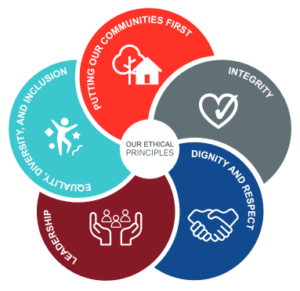
The Core Code of Ethics for Fire and Rescue Services sets out five ethical principles, based on the Seven Principles of Public Life, which alongside the accompanying guidance provides a basis for promoting good behaviour and challenging inappropriate behaviour.
Putting our communities first – we put the interest of the public, the community and service users first.
Integrity – we act with integrity, including being open, honest and consistent in everything we do.
Dignity and respect – making decisions objectively based on evidence, without discrimination or bias.
Leadership – we are all positive role models, always demonstrating flexibility and resilient leadership. We are all accountable for everything we do and challenge all behaviour that falls short of the highest standards.
Equality, diversity, and inclusion (EDI) – We continually recognise and promote the value of EDI both within the FRSs and the wider communities in which we serve. We stand against all forms of discrimination, create equal opportunities, promote equality, foster good relations, and celebrate difference.
Strategy Objectives 2026-29
Objective 1: Lead and influence
We will be a principal partner in shaping UK fire and rescue policy, reform and investment.
We will
- Provide evidence-based advice to ministers and policymakers on priority fire and rescue issues to inform policy and legislation and spending decisions including, using evidence and data to influence funding decisions to secure sustainable financial investment for FRSs (Revenue and Capital);
- support FRSs in local and national resilience by providing coordinated advice and assistance for major incidents, fire safety regulation and emerging risks;
- proactively engage with local, national and international partners, including academia, to identify and share learning and best practice;
- advise and influence ongoing Fire Reform, including the revision of the Fire and Rescue National Framework to ensure the roles of each of the key organisations including FRSs, Chief Fire Officers and the NFCC are clearly defined. To include advocating for the Operational Independence of CFOs;
- support the development, establishment and early operations of a College of Fire and Rescue, ensuring a smooth transition of those functions that are currently within the NFCC that are within the agreed College specification, into the new structure;
- develop a set of competency frameworks to create one shared model, providing a transparent, trusted and sector-owned foundation for professional practice across the UK; and
- maintain proactive engagement with devolved administrations to ensure NFCC is well placed to represent sector priorities and ensure alignment.
Objective 2: Empower and support
We will provide professional expertise, guidance and leadership to support UK fire and rescue services.
We will
- Develop and publish practical guidance, tools, and solutions to support FRSs in keeping communities safe;
- coordinate centralised national advice, and maintain peer review capability for complex building safety and Protection matters;
- provide targeted improvement support and advice to FRSs to enable measurable service improvement;
- promote and support the adoption of research, innovation, and best practice across UK FRSs;
- design and deliver NFCC leadership programmes to develop current and future fire and rescue leaders;
- support FRSs on culture reform to improve workforce inclusion, adaptability, diversity, and resilience through sector-wide guidance and support;
- enable FRSs to improve how they collect, manage, and use data and digital technology to support decision-making; and
- support innovation and collaboration with UK and international partners to help FRSs prepare for and respond to emerging and future risks.
Objective 3: Deliver with excellence and purpose
We will drive collaboration and innovation to maximise effectiveness and efficiency across UK fire and rescue services.
We will
- Maintain good governance to ensure accountability, compliance, ethical standards, and public benefit;
- facilitate and implement collaboration initiatives across FRSs, blue-light services and wider partners to maximise collective resources;
- work with government and key stakeholders to improve efficiency, productivity, and operational effectiveness across UK FRSs;
- maintain a sustainable, diversified funding model to support delivery against NFCC’s charitable objects; and
- identify, pilot, and scale innovative approaches in service delivery to improve efficiency and value for money.
Corporate Governance
Ensuring transparency and accountability
NFCC is a registered charity and company limited by guarantee. An independent membership association, which has existed in different forms since 1941. Every FRS in the UK is a member of NFCC, and in addition we have members from other jurisdictions including from outside of the UK.
NFCC’s Charitable Objects (the ‘Objects’) are:
- to lead, co-ordinate and support effective prevention, protection and emergency response – locally and nationally – to reduce the loss of life, personal injury and damage to property and the environment which can arise from fire, accident, major incidents and other emergencies;
- to support fire and rescue services in transforming their role to meet changing demands and resources for the benefit of the society;
- to promote effective service delivery working with partner organisations, governments, international partners and private sector bodies, and the community; and
- to maximise the effectiveness of the UK fire and rescue services in saving lives and increasing public safety by representing the professional voice of the United Kingdom’s fire and rescue services; to share knowledge and learning nationally and internationally.
Good governance at the NFCC ensures that decisions are consistent, fair and transparent. NFCC’s charitable objects underpin its work, whilst its membership enables representation and collective leadership. As both a charity and a membership organisation, NFCC’s governance is structured to reflect both roles – the dual structure set out below helps to ensure the NFCC is accountable as a charity while remaining led by its members.
Board of Trustees
The Board of Trustees form the ultimate governance body for NFCC and is charged with the responsibility for ensuring sound governance in terms of its obligations under Company Law and its responsibilities with its regulation as a charity by The Charity Commission.
The Board of Trustees are also responsible for monitoring progress against NFCC’s financial plans and delivery plan.
Chiefs Council
NFCC Chiefs Council is established under the articles of association, to drive improvement and development throughout the UK FRS and support strong leadership of the UK FRS including the devolved administrations. It is not a legal entity in its own right.
This 2026–2029 NFCC Strategy is underpinned by NFCC’s three-year Strategic Action Plan, which covers the same period. This ensures our work is coordinated and that all parts of NFCC are working towards the same shared aims and outcomes.
The Strategic Action Plan sets out how the priorities within this strategy will be delivered in practice. It provides the detailed roadmap for implementation, including specific actions, responsibilities and key performance indicators (KPIs) that will enable transparent monitoring of progress and impact. Delivery is structured around nine strategic priorities:
- Effective Preparedness, Response and Resilience
- Safer Buildings: Fire Safety and Protection
- Safer and Healthier Communities: Prevention and Safeguarding
- Developing and Supporting our People: Leadership and Culture
- Driving Digital, Data and Technology Development
- Continuous Improvement through Standards, Research, Learning and Guidance
- Shaping and Leading Fire Reform
- Influencing and Engaging: Communications and Public Affairs
- Delivering an effective, efficient, high-performing NFCC
The plan will be published alongside the strategy and updated where necessary to ensure it remains aligned with emerging risks and sector priorities.
Together, the strategy and action plan set out a bold, sector-led programme that strengthens national resilience, drives consistent high-quality practice, and supports a modern fire and rescue service equipped for today’s risks and tomorrow’s challenges. It positions the sector as a confident, evidence-driven leader shaping the future of public safety.
This strategy is shaped by extensive member and staff engagement through NFCC meetings and events, and the feedback received has been carefully considered and used to inform its development.
We encourage all fire and rescue services to reflect this strategy when developing local strategies and plans, including Community Risk Management Plans.