
Water Supplies for Firefighting Position Statement
1. Issue identification
Fire and rescue authorities have a legal duty to make provision for the purpose of extinguishing fires and protecting life and property in the event of fires.[1] To do this safely and effectively, fire and rescue services (FRSs) rely on access to reliable and sufficient water supplies. In most cases, this depends on infrastructure owned and operated by water undertakers, including fire hydrants and the wider water network.[2]
Water undertakers have legal responsibilities to support the provision of water for firefighting, although the legislative framework differs across the UK. In England and Wales, these responsibilities sit within the Water Industry Act 1991 and the Fire and Rescue Services Act 2004, with oversight from the relevant sector regulator.[3] However, FRSs are increasingly concerned that the current arrangements are not consistently providing the level of service needed to support effective firefighting, reflecting wider gaps in how the water system is designed, regulated, and delivered in practice.
FRSs are not recognised as key stakeholders within the water system, despite their critical role in protecting the public. Engagement from water undertakers is inconsistent, and there are no clear or enforceable expectations around service levels, performance, or accountability. Often, fire hydrants do not provide enough water flow for firefighting, and FRSs report inconsistencies in how water networks are designed and maintained, with delays in installing or repairing hydrants. In some cases, these delays can take months or even years to be resolved, potentially limiting the ability of FRSs to respond effectively and safely to incidents. Evidence collected from FRSs in summer 2026 indicated that 81% of respondents had changed their planned level of response in areas with known difficulties accessing sufficient firefighting water.[4]
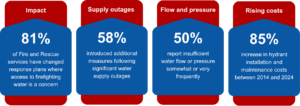
Operational impacts of firefighting water supply challenges reported by Fire and Rescue Services.
FRSs can be charged for hydrant installation and maintenance.[5] Returns from FRSs indicate that hydrant works charges increased by an average of 85% between 2014 and 2024, with limited transparency about how costs are calculated. Charges can also vary significantly between undertakers for similar work, reflecting differences in how water undertakers deliver services, including the use of third-party contractors. FRSs have little ability to challenge these costs, which places additional pressure on already stretched budgets.
These challenges are likely to grow. Climate change, population growth, and increasing demand for water are putting additional strain on infrastructure and are likely to reduce the availability of water for firefighting, particularly during periods of extreme heat and drought, when demand for emergency response is also higher. There is growing evidence that wildfires are affecting the rural-urban interface, where fires can spread from vegetation or open land towards homes and infrastructure. This makes access to suitable and reliable water supplies for wildfire response increasingly important. Higher-density housing, large warehousing, industrial and high-bay storage developments, data centres, battery energy storage systems, and other energy infrastructure are also increasing the need for reliable, high-capacity water supplies.
Wider gaps across the built environment, including the assurance of competence, the planning process, and design guidance also contribute to these problems. While progress has been made since the Grenfell Tower fire in defining competence standards, much of the resulting system remains voluntary. Firefighting water requirements are not always clearly identified during planning or when new buildings are designed. Developments may progress without adequate consideration of hydrant provision, water capacity, or access to firefighting water.
2. NFCC position
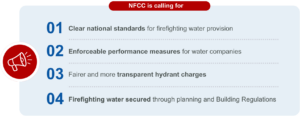
NFCC’s key recommendations to improve firefighting water provision and resilience.
Water for firefighting should be treated as a critical public safety requirement, with clear national standards and stronger accountability to ensure reliable provision based on life-safety requirements, effective emergency response, and foreseeable risk.
Access to reliable and sufficient water supplies for firefighting is essential for keeping the public safe. However, current arrangements for providing these supplies and maintaining infrastructure are not always adequate, affordable, or transparent, which can put significant pressure on FRSs and the communities they protect.
The Government has proposed reforms to the water sector in England, including plans for a new single water regulator responsible for both economic and environmental performance. The Welsh Government has also consulted on the future of water governance, recognising the need to consider policy and legislative changes to support its long-term vision for water. These developments mark a potential move towards more joined-up regulation of the water sector.
These reforms also create an important opportunity to more clearly recognise FRSs as key stakeholders and public safety partners within the water system. This means ensuring that firefighting needs are properly understood, planned for, and integrated into water resources planning, drought planning, and infrastructure investment decisions. This will require a stronger and more consistent approach to service standards, infrastructure resilience, and engagement between water undertakers and FRSs.
3. Recommendations
NFCC calls on relevant UK water regulator(s), under current and future arrangements, to:
- Establish clear, enforceable performance measures for water undertakers regarding the provision of water for firefighting, including the notification of network changes to FRSs, maintenance of hydrant infrastructure, provision of relevant network information, support provided to FRSs at incidents, and the quality and consistency of engagement with each FRS. These measures should form part of water undertakers’ regulatory performance reporting to the relevant regulator.
- Improve transparency, consistency, and oversight of hydrant installation and maintenance charges by issuing guidance on what costs should and should not be included, including reasonable cost ranges or benchmarking where appropriate, and ensuring charges are clearly identified, proportionate, consistently categorised, transparently reported, and subject to robust scrutiny within water undertakers’ Asset Management Plan and Annual Performance Report processes.
- Require clear national service standards for hydrant repair and maintenance, including categorised timeframes for critical and standard defects, escalation arrangements where timeframes are not met, and reporting requirements on delivery against those standards.
- Ensure that water undertakers establish, maintain, and periodically review effective local agreements and incident communication protocols with FRSs, in line with the Grenfell Tower Inquiry Phase 2 recommendation, with regulatory oversight of compliance and delivery.
NFCC calls on the UK and devolved Governments to:
- Ensure that FRSs are explicitly recognised within the reformed water regulatory framework as key stakeholders, and set clear expectations for the water regulator to oversee and enforce water undertakers’ existing duties in relation to firefighting water.
- Establish clear and mandatory technical standards for firefighting water provision, including minimum functional expectations for hydrant provision and flow rates, supported by a review of existing benchmarks to ensure they remain appropriate for modern development, emerging risks and technologies, and major incidents.
- Embed firefighting water requirements within planning policy so that new developments must demonstrate adequate provision can be secured before planning approval is granted, with developers and infrastructure designers responsible for identifying, funding, designing, and arranging the installation of necessary firefighting water infrastructure, including fire hydrants, appropriate mains capacity, and any required local water network reinforcement.
- Strengthen Building Regulations frameworks and guidance, including Approved Document B, to ensure that requirements for water supplies for firefighting are clearly defined, consistently applied, kept under review, and that adequate firefighting water infrastructure is verified before occupation, where it is required to support safe and operationally viable development.
- Ensure clear lines of responsibility and accountability for the provision, recording, notification, and maintenance of firefighting water infrastructure across all water providers, including in developments served by alternative providers.
- Introduce national exemptions or waivers from street works, permit, and lane rental charges that apply to fire hydrant works, recognising their role in supporting emergency response and public safety.
NFCC calls on water undertakers to:
- Ensure FRSs have appropriate access to water and underground asset information needed to support pre-planning and incident response, including consideration of direct or facilitated access to hydrant, main, District Metered Area mapping, and National Underground Asset Register or equivalent systems where relevant.
These proposals build on NFCC’s existing positions on Planning and Building Regulations and the wider findings and recommendations arising from the Grenfell Tower Public Inquiry.
4. Supporting evidence
Operational challenges and infrastructure performance
Firefighting operations can require significant volumes of water, often requiring the use of multiple jets and sustained high flow rates, depending on the nature and scale of the incident. Evidence from the Grenfell Tower Inquiry highlighted the operational impact that insufficient water flow and pressure can have during a major fire, including limitations on firefighting activity, reduced vertical reach of main jets, and the need to pause firefighting to allow appliance tanks to refill. This learning is particularly relevant as high-rise buildings, complex site layouts, high-density developments, and large-footprint commercial and industrial sites become more common across the UK.
FRSs report ongoing challenges in accessing reliable water supplies, including inadequate hydrant flow rates and pressure, variability in network design and maintenance, delays in hydrant installation or repair, and late or no notification when works are completed. Older mains infrastructure may limit the ability of water undertakers to increase flow or pressure during incidents, due to the risk of pipe fracture or failure, while newer mains may be designed primarily around expected domestic or commercial demand rather than firefighting need. FRS feedback also indicates that changes to water networks, including mains being downsized from 90mm to 63mm, are not always notified to FRSs, which can affect hydrant suitability and operational pre-planning.
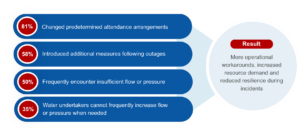
Water supply issues are affecting operational response across Fire and Rescue Services.
An NFCC survey of FRSs undertaken in summer 2026 provides further evidence of the extent of these pressures. Half of respondents said crews encountered insufficient flow or pressure somewhat or very frequently, while 35% said water undertakers were unable to increase flow or pressure somewhat or very frequently. 58% of responding FRSs had introduced additional measures because of significant water outages, and 81% had changed predetermined attendances in areas with known difficulties accessing sufficient firefighting water.
FRSs also require timely access to appropriate water network information, including hydrant, main, District Metered Area, and flow constraint mapping where relevant. This supports pre-planning, any planning consultations, and incident response by helping FRSs identify alternative hydrants or supplies that may maximise available water without unintentionally drawing multiple hydrants from the same constrained main. Local examples, including joint work between London Fire Brigade and Thames Water, show how improved geographical mapping can help identify the best available hydrants near an incident and highlight areas of poor flow during planning consultations. NFCC would welcome wider access to comparable data and tools across FRSs, provided they are kept up to date and supported by clear arrangements for data sharing, training, and incident use.
Inadequate water supply can directly affect operational response. FRSs may need to deploy additional fire appliances and specialist equipment, including high volume pumps, to transport water over long distances. It can also divert crews during the early stages of an incident, when they would often be focused on making an initial attack on the fire, towards locating alternative hydrants, drawing from different mains, or securing other water sources. This can delay effective firefighting action, potentially allowing fires that may otherwise have been more manageable to develop further, increasing risk to both firefighters and the public, as well as property damage, business interruption, and wider economic loss.
Operational decisions about where FRSs can draw water can also be affected by water undertaker priorities to maintain supply to nearby domestic and commercial customers. For example, where high volume pumps are connected to pressure-fed supplies, FRSs may be asked to draw from a strategic main further from the incident ground to maximise available water while reducing the impact on local customers. This can be operationally appropriate in some circumstances, but it may also increase distance, complexity, and time during an incident.
The Water UK National Guidance Document on the Provision of Water for Firefighting highlights that, while water undertakers have duties to maintain an efficient and economical supply system, there is no consistent mandatory national standard for firefighting flow rates or infrastructure design. As a result, service provision varies across the country and often relies on local agreements, leading to inconsistent outcomes.
Resilience and future pressures
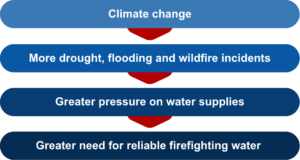
Climate change is increasing pressure on water supplies and the need for reliable firefighting water provision.
FRSs are increasingly experiencing the impacts of climate change, including more frequent extreme heat, drought, flooding, and wildfire incidents. Water supply resilience has also been given greater prominence in the 2026 National Risk Register, which assesses water infrastructure failure or loss of drinking water as a catastrophic-impact risk and introduces a separate risk relating to cyber attack on water infrastructure. The Register also identifies that hazards such as drought and wildfire are very likely to occur concurrently with, or immediately after, periods of extreme heat, placing additional strain on water availability and emergency response capacity. There is growing evidence that wildfires are affecting the rural-urban interface, where fires can spread from vegetation or open land towards homes and infrastructure. This makes access to suitable and reliable water supplies for wildfire response increasingly important, particularly where incidents may transition from rural firefighting into the protection of communities and the built environment.
Flooding can also affect the availability and usability of firefighting water infrastructure. In lower-lying or flood-prone areas, hydrants may be inaccessible, submerged, damaged, or difficult to locate and operate safely during an incident. Future water infrastructure planning should therefore consider not only drought and water scarcity, but also the resilience and accessibility of hydrant networks and other climate-related disruption.
The Government also predicts a total 5 billion litres per day shortfall in water availability by 2055, highlighting the growing pressure on water resources and the need to ensure that critical services such as firefighting are fully considered within future system planning. Firefighting water requirements should therefore be reflected in water company drought plans, regional water resources plans, and wider supply-demand forecasting. This would support earlier identification of areas where water scarcity, environmental constraints, network limitations, or drought measures may affect firefighting capability, and would enable pre-planning with FRSs before risks materialise during an incident. Environmental protection must remain an equal priority, particularly where firefighting operations may involve high water use, abstraction from alternative sources, or contaminated fire-water runoff. Better integration between water resources planning, environmental protection, and emergency response planning would support safer and more sustainable outcomes.
This follows a prolonged gap in strategic investment into water infrastructure, as no major new reservoir has been completed in the UK since 1992. Although one reservoir is now under construction, and nine new reservoirs are planned in England, these schemes have long lead-in times, reinforcing the need for firefighting water requirements to be considered from the outset in long-term water resources and infrastructure investment planning.
Emerging high-water-demand sectors, including data centres, may place additional pressure on already constrained water networks, particularly during periods of hot weather when wider water demand and the risk of fire may also be elevated. At the same time, population growth, ageing infrastructure, and changes to the built environment are increasing demand for water and placing further pressure on existing systems. Without improvements to infrastructure resilience and regulatory oversight, these trends are likely to exacerbate existing challenges and increase risks to public and firefighter safety. Where new or upgraded water infrastructure is being designed, there may also be opportunities to future-proof networks so they can better support wider fire safety improvements over time, including potential future or retrospective sprinkler provision where this is appropriate and technically feasible.
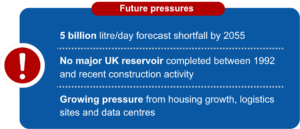
Future pressures on UK water supplies.
Regulatory framework
FRSs are not consistently recognised as key stakeholders of the water system or as customers of equal importance to domestic and commercial consumers. FRS Water Officers continue to report variable engagement between water undertakers and FRSs, alongside a lack of clear, enforceable expectations on service levels, performance, and collaboration. NFCC has previously called on Ofwat to introduce specific performance measures to assess how water undertakers support FRSs, including in relation to hydrant maintenance, water availability, and support at incidents. In doing so, regulatory arrangements would provide improved oversight and accountability for firefighting water provision.
The Government’s January 2026 White Paper, A New Vision for Water, identifies a range of structural challenges across the water sector, including ageing infrastructure, fragmented planning, overlapping regulatory processes, and a lack of clear, joined-up direction. It also notes that around 60% of water mains were built before 1981, with 13% now over 100 years old. These issues contribute to inconsistent delivery and limit the ability of the current framework to support public safety outcomes effectively.
This pressure is compounded by leakage and network efficiency measures. Ofwat data indicates that around 2,966.5 megalitres of water are lost to leakage each day across England and Wales. While reducing leakage is important, one way of managing leakage is to reduce pressure and water volumes within the network. This can have unintended consequences for firefighting where it reduces the water available from hydrants or delays the ability of the water undertaker to increase supply during an incident. FRSs have also raised concerns that routine variation or reduction of mains pressure is not always notified, even where it may materially reduce firefighting water availability. Where pressure reductions or network management measures affect firefighting capability, FRSs should be notified by geographic area, with clear information on expected minimum pressure, the likely duration of the reduction, and the arrangements and maximum timescales for increasing supply during an incident.
These wider issues contribute to inconsistent delivery and limit the ability of the current framework to support public safety outcomes effectively. However, the White Paper does not meaningfully consider the impact of these challenges on FRSs or firefighting.
Charging, transparency, and affordability
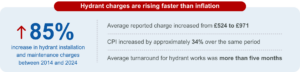
Hydrant installation and maintenance costs are rising significantly faster than inflation.
FRSs have raised significant concerns about the cost and transparency of hydrant installation and maintenance charges. NFCC evidence from a survey of FRS Water Officers shows that hydrant works charges increased by an average of 85% between 2014 and 2024, significantly outpacing the CPI inflation rate, which was approximately 34% over the same period. Some FRSs report even sharper increases between 2022 and 2025, including hydrant replacement costs rising by over 150%, frame and cover costs increasing by around 194%, and FRS water officer inspection-related costs, such as time to locate hydrants, increasing by over 100%. One FRS saw the cost of a new fire hydrant installation increase by 200% in a single year from 2025 to 2026.
There is also significant variation in charges between undertakers and areas. One FRS reported that charges for installing the same type of new hydrant on new developments can range from £468 to £877 depending on the water undertaker. The same FRS also reported that the average charge for a full hydrant renewal following a defect currently averages at £2,057, which represents an increase of £629 over the past five years. Other FRSs can be charged up to £5,000 per hydrant where traffic management is included. One FRS also reported that traffic management costs associated with hydrant works increased by 300% in a single year. This demonstrates the absence of a consistent national pricing structure and the degree of variation FRSs can face for similar or comparable works.
These pressures are compounded by a lack of transparency in how charges are calculated. Minor works can be grouped into broad charging categories, resulting in disproportionately high costs, while charges for identical tasks can vary significantly between areas. The absence of a standardised tariff or defined scope of works means charges are not always clearly linked to the activity undertaken. This raises concerns that FRSs may be paying charges that go beyond reasonable cost recovery, with limited ability to test whether costs are necessary, proportionate, or directly linked to the work undertaken. FRSs also report that charge increases are not always subject to meaningful prior engagement, making it difficult for FRS water teams to plan budgets year on year. This is particularly challenging where FRSs have limited ability to challenge or negotiate charges but remain responsible for maintaining operational readiness and ensuring defects are addressed.
Some costs incurred during hydrant repairs may arise from underlying infrastructure design choices. For example, specialist equipment may be needed to maintain water supply during works where isolation valves have not been installed. FRSs have also raised concerns that some hydrant designs cannot easily be repaired in situ, meaning replacement may be required even where repair would otherwise be more proportionate. Greater standardisation of hydrant specification, repairability, safe isolation, and maintenance requirements would support more effective, maintainable, and fit-for-purpose assets.
There are also inconsistencies in the application of street works, permit, and lane rental charges. While many highway authorities exempt fire hydrant works from permit fees, there is no national requirement to do so, and approaches can vary between regions and even within a single FRS area. FRSs do not always have visibility of whether such charges have actually been incurred, waived, or avoided before costs are passed on by water undertakers. In some cases, concerns have been raised that water undertakers may pass on permit or lane rental charges to FRSs even where those charges have been waived or could have been avoided.
Ofwat has taken steps to increase reporting in this area, but current proposals remain relatively high-level and rely largely on retrospective review of performance data rather than proactive, standardised requirements. FRSs would benefit from a consistent and transparent framework for hydrant works charging, including standardised categories of work, clearer cost breakdowns, and reporting requirements covering volumes of work, timeliness, and outcomes.
Planning and development system
Firefighting water provision is often dependent on decisions made before construction begins. However, these requirements are not always clearly identified or secured at the planning stage, including through planning conditions or Section 106 obligations.[6] This can result in developments progressing without sufficient firefighting water infrastructure, or with uncertainty about who is responsible for funding and delivering it.
These issues can become significantly harder to resolve at the Building Regulations stage. FRSs report examples of plan submissions without fire hydrants or other relevant fire assets included, with an expectation that the FRS will identify and mark-up what is required. This is not a sustainable or appropriate substitute for competent design, and it does not provide assurance that FRS requirements will be carried through to final site plans or installed infrastructure.
This is compounded by guidance. Approved Document B provides guidance on one way of meeting the Building Regulations, but requirements relating to access and facilities for FRSs, including water supplies, remain open to interpretation and have not been subject to the full review NFCC considers necessary. Relying on Building Regulations approval alone may not resolve issues embedded through planning decisions, particularly where layout, access, water network capacity, or firefighting infrastructure have already been determined.
The issue is not simply timing, but whether developers and clients have adequately ensured that the water supply needed to support firefighting facilities can actually be delivered. Requirement B5 of the Building Regulations states that a building should be designed and constructed so as to provide reasonable facilities to assist firefighters in the protection of life. Where buildings are designed with fire mains, but the surrounding water network cannot provide the flow needed to support effective firefighting, the practical effectiveness of those facilities can be undermined.
Recent FRS feedback highlights examples where developments with very low available water supplies have either required consideration of substantial tanked water provision to support dry-riser use, or have relied on historic planning approvals despite known deficiencies in the local network. There is also limited formal sign-off of fire hydrants and associated firefighting water infrastructure before occupation, and limited ability to require remedial action where deficiencies are identified late.
In some cases, FRSs may only become aware of new infrastructure when attending an incident, meaning hydrants may not have been captured on FRS systems and crews may face difficulty locating or using them.
The solution should not rely on FRSs compensating for gaps in design competence by identifying or designing the necessary provision themselves, or taking on responsibilities that properly sit with developers, designers, and other dutyholders. FRS engagement should provide operational input where appropriate, not substitute for competent design and effective assurance. Planning authorities, developers, water undertakers, and building control bodies should be supported by clear national requirements and sufficient competence to ensure that firefighting water provision is identified, secured, and recorded consistently.
Benchmarks in guidance
There is a risk that water provision assessed as adequate at one stage may not remain adequate over time. Future changes to the water undertaker network, or additional demand from nearby development served by the same supply, can reduce the flow or pressure available to existing buildings. For buildings subject to Planning Gateway One under the Building Safety Act 2022, access to water may be considered, but there is no equivalent mechanism to ensure that the same level of provision is maintained as the wider network changes.
BS 9990:2015 provides guidance for buildings which require non-automatic firefighting systems, including wet and dry firefighting mains. For these buildings, BS 9990:2015 provides a benchmark of around 1,500 litres per minute, or 25 litres per second, for firefighting water supply, though this is guidance rather than a mandatory requirement.
The latest Water UK National Guidance Document on the Provision of Water for Firefighting also includes a range of minimum flow rates, which draw on research undertaken at 5,400 working fires by Glasgow Caledonian University and associated NFCC operational guidance for firefighters. However, the relationship between these benchmarks, Approved Document B, and the practical requirements for dry-rising and wet-rising mains is not always clear or consistently applied. Evidence from FRSs indicates that some developments are designed on the basis of expected firefighting flow rates, but, in practice, the available on-site supply is significantly lower, in some cases around 228 litres per minute (below four litres per second). In other cases, smaller diameter mains, such as 63mm pipes designed for domestic supply, are being used in ways that cannot support hydrants or deliver sufficient water for firefighting.
One FRS has reported being asked to meet the cost of replacing 63mm mains that are unable to provide sufficient firefighting water. In another development where new pipework was connected to an existing 63mm main, the water undertaker sought to recover the replacement cost from the FRS. The FRS considered the developer should meet the cost, having commissioned the work, but the developer had dissolved. The FRS subsequently needed to increase the predetermined attendance for the area to manage the resulting operational risk.
Benchmarks, standards, and guidance should be reviewed, aligned, and, where appropriate, placed on a clearer mandatory footing to provide a consistent basis for assessment. This should include consideration of modern development, higher-density buildings, emerging technologies such as domestic or community battery energy storage systems, and major incidents that may require sustained or significantly higher volumes of water.
In high-rise and medium-rise buildings, insufficient flow can directly affect operational tactics, vertical firefighting capability, firefighter safety, evacuation (including arrangements for residents who may require assistance), and the ability to sustain operations over time. For buildings where firefighting activity may need to be undertaken at height, the available supply should be tested against the intended firefighting strategy, including whether it can support operations on upper floors during a protracted incident. High-rise and relevant medium-rise developments where similar operational issues may arise should therefore demonstrate at planning and Building Regulations stage, including through Planning Gateway One and Gateway Two where applicable, that external hydrant provision, water main capacity, fire main performance, and any supplementary water supplies are suitable for the proposed building height, layout, occupancy, evacuation strategy, and anticipated FRS intervention.
Large warehouse, logistics, industrial, and high-bay storage developments can also create significant demand for sustained firefighting water because of their scale, fire load, building footprint, compartment size, racking arrangements, external yard layout, and reliance on FRS intervention. Where a development relies on sprinklers, private hydrants, tanks, fire mains, or other on-site infrastructure, this should not remove the need to demonstrate that adequate water is available for firefighting operations. The responsible water undertaker or New Appointments and Variations company (NAV) should confirm the available supply, any network constraints, maintenance arrangements, emergency contact routes, and measures needed to increase or manage supply during an incident. Hydrants and other firefighting water infrastructure must remain visible, accessible, usable, and maintainable throughout the life of the development, not only at initial completion.
The increasing use of alternative water providers through NAVs and self-lay providers can further complicate these issues. FRSs are not always notified of the responsible provider for new developments, limiting opportunities for early engagement. This has led to examples of developments being delivered without adequate hydrant provision, or with unclear arrangements for maintaining and repairing firefighting water infrastructure once in place. There are also examples of new developments served by NAVs where the boundary connection from the water undertaker’s network has not been suitably sized, or does not include a bypass facility, to allow an increased supply of water to the site for firefighting. This can effectively design out the ability of the water undertaker to increase the supply of water for firefighting in an emergency, as envisaged under section 40 of the Fire and Rescue Services Act 2004.
FRSs also report sites being adopted from NAVs or self-lay providers without adequate inspection of firefighting water infrastructure. This can result in hydrants being missing, defective, obstructed, filled with construction materials, or covered by later surfacing works. Where this occurs, new developments may have insufficient hydrant coverage for prolonged periods, requiring FRSs to manage the risk operationally through local risk records or pre-planning arrangements rather than the issue being resolved through the development, adoption, or regulatory process.
Where firefighting water requirements are considered early, planning authorities, developers, water undertakers, and building control bodies are better able to identify whether hydrant provision, hose-laying distances, network design, and water capacity are likely to support safe and operationally viable development. For defined higher-risk or more complex developments, early engagement with FRSs can help identify site-specific risks, including those associated with nationally significant infrastructure projects, complex layouts, constrained access, large warehousing and logistics sites, and emerging energy technologies. However, this should be supported by clearer national guidance and strengthened competence across the planning and construction system, so that firefighting water provision is considered consistently and is not dependent on discretionary or late-stage engagement.
References
Town and Country Planning Act 1990.
Fire and Rescue Services Act 2004.
The Fire and Rescue Services (Northern Ireland) Order 2006.
British Standards Institution, BS 9990:2015 – Non automatic fire-fighting systems in buildings, Code of practice, January 2015.
Grenfell Tower Inquiry, Evidence from Dr Stoianov.
NFCC, Inland Water Safety Position Statement, September 2024.
NFCC, Climate Change Position Statement, February 2025.
Water UK, National guidance document on the provision of water for firefighting, 4th edition, June 2025.
Environment Agency, National Framework for Water Resources 2025: water for growth, nature and a resilient future, June 2025.
Independent Water Commission, Review of the water sector, July 2025.
Ofwat, Water Company Performance Report 2024–25, October 2025.
NFCC, Building Regulations and Guidance Position Statement, December 2025.
Department for Environment, Food & Rural Affairs, A new vision for water: white paper, January 2026.
Welsh Government, Green Paper: Shaping the Future of Water Governance in Wales, February 2026.
NFCC, Response to MHCLG consultation ‘National Planning Policy Framework: proposed reforms and other changes to the planning system’, March 2026.
NFCC, Planning Position Statement, March 2026.
Office for National Statistics, Inflation and price indices 2015–25.
MHCLG, Approved Document B.
Cabinet Office, National Risk Register 2026, July 2026.
Footnotes
[1] The Fire and Rescue Services Act 2004 applies principally to England and Wales. Equivalent provision is made in Scotland under section 9 of the Fire (Scotland) Act 2005, which requires provision for extinguishing fires and protecting life and property in the event of fires. Separate provision is made for Northern Ireland under the Fire and Rescue Services (Northern Ireland) Order 2006.
[2] For the purposes of this position statement, ‘water undertakers’ means the statutory water companies responsible for water supply, including Water and Sewerage Companies, Water Only Companies, and relevant New Appointments and Variations providers.
[3] The Water Industry Act 1991 applies to England and Wales. In Scotland, separate provision is made through the Fire (Scotland) Act 2005 and the Water (Scotland) Act 1980, including provisions relating to water supply and fire hydrants. In Northern Ireland, separate provision is made through the Fire and Rescue Services (Northern Ireland) Order 2006 and the Water and Sewerage Services (Northern Ireland) Order 2006.
[4] Responses to NFCC’s survey were received from 50% of UK fire and rescue services, including 55% of English fire and rescue services.
[5] In accordance with the Water Industry Act 1991, part III, chapter II, section 57.
[6] Section 106 of the Town and Country Planning Act 1990 enables planning obligations to be entered into in connection with land development. In this context, such obligations may be used to secure infrastructure or contributions linked to development, including firefighting water infrastructure where appropriate.
