Prevention Award Winners 2024
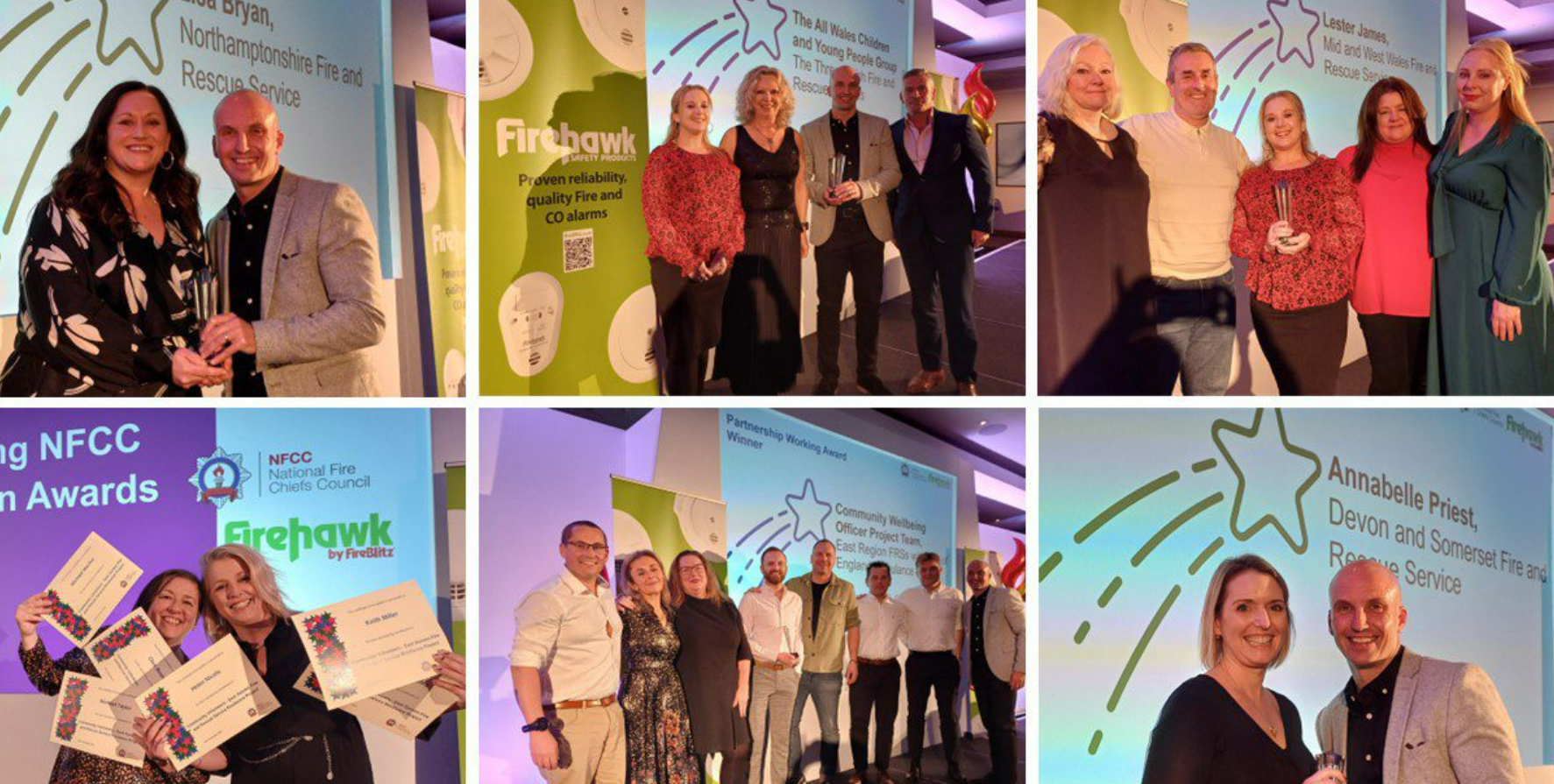
The Donna Crossman, Children and Young People Award – Lester James, Mid and West Wales Fire and Rescue Service.
Partnership Working Award – Community Wellbeing Officer Project Team, East Region FRSs (Bedfordshire FRS, Cambridgeshire FRS and Essex County FRS) with East of England Ambulance Service.
Outstanding Contribution – Dawn Whittaker, CFO East Sussex Fire and Rescue Service and National Water Safety Lead.Winners 2024
Children and Young People Award – The All-Wales Children and Young People Group, The Three Welsh Fire and Rescue Services.
Home Safety Award – Humberside Prevention Team, Humberside Fire and Rescue Service.
Road Safety Award – Annabelle Priest, Devon and Somerset Fire and Rescue Service.
Safeguarding Award – Lisa Bryan, Northamptonshire Fire and Rescue Service.
Water Safety Award – Prevention Department, East Sussex Fire and Rescue Service
Partnership Working Case Study
Community Wellbeing Officer Project Team, East Region FRSs with East of England Ambulance Service.
The innovative Comunity Wellbeing Officer (CWO) project is an initiative led by the East of England Ambulance Service (EEAST) and Fire and Rescue Services in the East Region (Bedfordshire, Cambridgeshire and Essex). It is designed to improve collaboration where response and prevention can be undertaken simultaneously to increase patient and community outcomes, save money, and reduce risk.
Concentrating on three areas of concern (those at risk of falling in the home, the necessity of fire safety awareness with this group, and delayed response times), the organisations worked together effectively, to improve safety measures for this risk group, provide holistic care, and maximise resource efficiently.
The innovative project enables the community well-being officers to address fall related injuries and conduct fire safety and prevention assessments during a single visit. Involving extensive planning and stakeholder engagement, alongside the Ambulance Integration Directorate, project management offices, finance teams and FRS colleagues in both response and prevention roles, through co-design of the new role, recruitment, training and equipment requirements.
Service outcome measures developed to track improvements in response times reduction proved effective. Fire safety visits gathered intelligence for referrals to approved providers, including Control Systems which identified bed-bound patients living at home, who would not be able to evacuate following a fire.
The results – both quantitative and qualitative data has been used to track best practice in this collaboration. All Services have yielded significant positive outcomes:
- In respect to low acuity fall calls, the CWOs arrive on average 70 minutes, against the ambulance trust average of 135 minutes for patients at the same code
- Joint training sessions and workshops are regularly conducted bringing together ambulance and fire staff to review case studies, discuss challenges and share successful approaches.
- CWO Teams have attended 528 calls during this collaboration arriving ahead of EEAST at 93 % of lower acuity calls
- 43% of lower acuity calls have been closed without the need of a dual staff ambulance (DSA) meaning DSA capacity is released back to the Ambulance Service
- In first 6 months, over 500 smoke alarms were fitted by CWO Teams, 29 CO alarms issued along with 80 patients being given fire prevention and protection advice
- 3,839 additional on duty response hours logged with the Ambulance Service to attend 999 calls, creating extra response capacity
- Qualitatively, patient testimonials highlight increased satisfaction and feelings of safety.
- The organisations involved in the project have implemented multiple strategies to share learning and best practise locally and beyond
- The collaboration between ambulance and fire service strength in the relationship, which increases trust and understanding in each other’s service and removed many barriers to wider collaboration
- The project has led to significant efficiency gains not only in the community wellbeing role itself but in other work streams such as category one response, complex rescue, and operational agreements such as forced entry to falls behind closed doors
Water Safety Case Study
Prevention Department, East Sussex Fire and Rescue Service
Following the initial publication of drowning statistics in 2016 that identified East Sussex had the second highest number of drownings nationally, ESFRS established a water safety workstream delivered through the role of a water safety practitioner.
Supported by our CFO and driven by our Partnership Manager, we established links with RNLI, RLSS, National Water Safety Forum and HM Coastguard and developed a water safety strategy that mirrored the aim of halving drownings by 2025.
We identified that the highest risk cohort were young people in East Sussex and university students in Brighton & Hove and now work collaboratively with charities and statutory agencies to promote Don’t Drink & Drown & FLOAT campaigns aligned with Fresher’s Week and delivered through the Brighton & Hove water safety forum.
Water safety education is vital and, in some instances, could be a child’s only opportunity to learn about the water. We believe that water safety education should be accessible to all. In an ideal world, every child would learn to swim. However, as this is not the case, in collaboration with the RNLI, we have developed Water Savvy Water Safe WS², delivered primarily to year groups in schools as well as to Home Educated children to offer practical advice and education on making sensible decisions to avoid water related harm, including the risks of tombstoning, cold water shock and riptides.
We work closely with Public Health partners to identify prevention opportunities to reduce water related suicide.
We collaborated with HM Coastguard and the RNLI to produce the film Robbie’s Story, which hears from Robbie as he tells the story of losing his dad Gareth to the sea in January 2021. The film has been incorporated into our WS² presentation with Robbie attending presentations to talk about the impact Gareth’s death has had on those left behind. The hope is this that this will help to educate students on the dangers of open water and prevent anyone else suffering the same fate.
We developed 10 short TikTok films to support our water safety messages, one film achieving 500,000 views globally.
ESFRS Prevention developed a suite of water safety resources augmented by RNLI resources, deliverable at all station open days and public events where appropriate and our Safety In Action practical scenarios for Year 6 students.
Circa 10,000 CYP have received water safety education over the last 12 months. Evaluation of these programmes has yielded incredibly positive results, demonstrating significant advancements in participant knowledge and engagement post intervention. Feedback indicates that participants not only grasped key concepts but also expressed a strong intention to apply this knowledge in their daily practices. This heightened awareness and understanding have set the foundation for meaningful behaviour change. We will build on this momentum by implementing targeted strategies that reinforce these learnings, ensuring sustained improvements and fostering a culture of continuous development within the prevention department.
Through our collaborative effort we are delighted that WAID stats recorded no accidental drownings in East Sussex in 2023