2025 Celebrating Prevention Awards
Nominations now closed.
NFCC’s Celebrating Prevention Awards 2025 are returning for the fourth year, recognising and celebrating the achievements of Prevention activity in fire and rescue services across the UK.
The awards will take place on the evening of Thursday 27 November as part of the NFCC Prevention Conference and this year they promise to be even bigger and better!
Last year more than 70 nominations were received by the judging panel recognising the incredible work FRSs are undertaking across road, home and water safety, as well as safeguarding, children & young people and partnership working. Nominations for 2025 are now open so it’s time to shout about the life-saving, pioneering initiatives happening across Prevention at your fire and rescue service.
Let’s celebrate Prevention – individuals, teams and partners!
All you need to know
All nominations must be made by 12 September 2025
General information
- All nominations are to be submitted through the online submission, entries sent via email or PDF will not be accepted.
- Nominees may include individuals, teams, partnerships, or initiatives based in the UK for fire and rescue.
- Entries must demonstrate impact within the past 12 months (September 2024 – August 2025).
- Supporting evidence (e.g. testimonials, case studies, data) is encouraged but not mandatory, unless stated.
- Deadline for submissions: Friday 12 September 2025.
- Individuals may be nominated for more than one category, but separate nominations must be submitted.
- Past winner entries cannot be submitted again (only if it is significantly different or shows continued impact).
- Self-nominations are accepted with adequate supporting evidence or references.
Eligibility criteria for nominations
- Nominees must be actively involved in fire prevention or related areas (e.g. home safety, road safety, safeguarding, water safety, or partnership initiatives), working for a UK FRS.
- All categories are open to cross-sector partnerships with fire and rescue services – volunteers are unfortunately not eligible.
- Celebrating Prevention Awards are not open to external partners or organisations. For the Partnership Working Award, a fire and rescue service must be included in this partnership.
Nominations must:
- Have had a demonstrable impact within the UK.
- Have been implemented or demonstrated impact within the last 12 months (since September 2024).
- Operated within the UK and contribute to national or community-level fire prevention and safety efforts.
- Nominees should demonstrate innovation, leadership, or best-practice approaches in their category of work.
Other considerations:
- Equity & Inclusion: Does the work address inequality or reach underserved communities?
- Leadership: Has the nominee demonstrated outstanding leadership or mentorship?
- Sustainability: Is the initiative designed for long-term impact or adaptation?
Apply here
All nominations are now closed.
2025 Celebrating Prevention Award Categories
Children and Young People Award
Inspiring ‘Safer Futures’ in our children and young people (CYP), this award recognises a team’s impactful work that empowers and protects young people through fire and intervention prevention education.
Judging Criteria:
- Innovation in engaging children and young people around fire safety.
- Supports the CYP network in delivering competency and development.
- Evidence of youth participation or co-design (tools or advice to support children and young people to be safe, healthy, resilient and active participants in their community).
- Knowledge and evidence of any engagement or intervention whether it be targeted or universal.
The Donna Crossman Award (CYP)
This award is for an individual who in Donna Crossman’s legacy, demonstrates outstanding commitment to youth safety, honouring exceptional dedication to improving fire safety and intervention prevention for children and young people, through positive impact. This could include any engagement or intervention whether it is targeted or universal (societal).
Judging Criteria:
- Long-standing commitment to CYP fire safety and wellbeing.
- Legacy of inspiring leadership or advocacy.
- Demonstrates impact on behaviour change or safety outcomes from their work (fewer incidents, increased awareness).
- Knowledge and evidence of any engagement or intervention whether it be targeted or universal.
Home Safety Award
Creating safer homes and safer communities, the excellence of efforts in this award, celebrates innovative and effective approaches to reducing fire risks in homes and educating its community to adopt safer behaviours though prevention activities – demonstrating a developed and evidence in evaluation.
Judging Criteria:
- Evidence of measurable reduction in home fire incidents or risks, through delivering effective, efficient, and targeted prevention activities.
- Demonstrate to deliver engagement and education to its community in adopting safer behaviours, through the use of innovative tools, data, or community engagement strategies, including increasing collaboration with partners.
- Demonstrate the development and evidence of evaluation, though ways of working, that have made a significant difference to prevention delivery in the community.
- Evidence work with FRSs and partners to champion the Online Home Fire Safety Check tool, NFCC products and related campaigns.
Partnership Working Award
United in partnership excellence, this award honors outstanding multi-agency collaboration that advances national fire prevention goals in the community and champions fire prevention outcomes in the sector.
External applications can only be submitted for those who demonstrate and evidence partnership working with an FRS.
Judging Criteria:
- Demonstrate success through multi-agency collaboration, with clearly defined roles and shared goals between partners.
- Evidence that community improvement has been achieved, through sustainability and scalable outcomes. This includes evidence of Organisational Learning within the FRS.
- Deliver strong engagement and support at national, regional and local levels for co-design and support to FRS prevention functions.
- Develop and champion leadership and resources for prevention activities.
Road Safety Award
Recognising excellence in initiatives that reduce fire-related road incidents, promote safer driving behaviours and vehicle safety through education and leadership in the community. Demonstrates great contribution, support and commitment to advocate and enable the development of road safety prevention activities.
Judging Criteria:
- Evidence on reduction of incidents through delivering effective, efficient, and targeted prevention activities.
- Demonstrate the development and support in road risk reduction education and engagement, with clear evidence in making a difference to prevention delivery in the community, in adopting safer behaviours, including through partnerships with the transport, emergency, or education sectors.
- Alignment with national or regional road safety priorities.
- Evidence support of national Road Safety campaigns and encourage coordinated local delivery.
Safeguarding Award
Recognising an individual or team that champions safeguarding, through initiatives that protect vulnerable individuals and their communities, through integrated fire safety and safeguarding work. Demonstrating great contribution to advocate and safer safeguarding practices at a local and national level.
Judging Criteria:
- Evidence of meaningful outcomes that have improved safety and wellbeing for vulnerable people.
- Demonstrates efficient and effective safeguarding practices to safeguard the community, people and organisation.
- Champions safeguarding within their service and/or the wider sector on a local and/or national level.
- Introduction of creative solutions to safeguarding challenges, through strong partnership working across agencies, sectors, or teams.
Water Safety Award
Excellence in delivering effective, efficient, and targeted prevention activities in water safety. Celebrating innovative programs that integrate fire prevention with water safety for holistic community protection, to reduce risk and save lives, through education to adopt safer behaviours.
Judging Criteria:
- Demonstrates and measurable-evidence a proactive approach to reducing water-related incidents through effective, efficient, and targeted prevention strategies.
- Evidence of delivering impactful water safety education and engagement that promotes safer behaviours within the community.
- Demonstrates support for national Be Water Aware campaign and coordination with wider sector efforts, including adoption of national toolkits and initiatives. At a local level, evidences strong collaboration with local or national water safety organisations, emergency services, or rescue agencies.
- Evidence of supporting and aligning with the UK Drowning Prevention Strategy to reduce the number of accidental drownings and other national water safety priorities.
Top Tips for an Winning Award Entry
NFCC Head of Prevention, Sarah Mason shares her top tips to create a winning award entry.
Being a judge on the previous Prevention Awards was a humbling experience, truly inspired by some of the remarkable applications from across our Prevention activity.
There were some extraordinary entries full of statistics, passion, experience, and they made judging easy and inspiring! There were also some one-line explanations and some that had LOTS of words. I have been asked ‘what makes a good entry?’ and ‘what are the judges looking for?’
Sarah's Top Tips
1. Prove it
The judges love numbers and evidence. It helps with the “so what question” and shows the tangible impact of the nominated work. You can include testimonials, case studies, or relevant data to back up your nomination. Visual aids like charts or graphs can also help convey these achievements effectively.
2. Tell a compelling story
Share the journey behind the achievements, including challenges that have been overcome. A well-told narrative will make your nomination memorable. Structure your story with a clear beginning, middle, and end. Describe the problem or opportunity faced, the innovative solutions you implemented, and the successful outcomes.
3. Be clear, concise and proofread
Avoid jargon and lengthy paragraphs. Make your nomination entry easy to understand and straight to the point. Think of the key achievements and keep your language accessible to a broad audience.
Start strong with an engaging introduction that summarises your case in one or two sentences. Follow this with clear sections, and conclude with a powerful closing statement that reinforces why this nomination deserves the award.
Errors can detract from the professionalism of your entry. Review it multiple times or have someone else check it for you. Spelling and grammar mistakes can undermine even the strongest submission.
4. Customise your submission
Do not use a “one-size-fits-all” application for multiple awards. Tailor each entry to the specific award criteria, showcasing the aspects of the work that best aligns with what the judges are seeking.
5. Engage the judges’ emotions
While facts and figures are crucial, do not underestimate the power of emotional appeal. We work in prevention for the human impact of our work – stories of community improvement, challenging overcome, teams working together.
6. Checklist for success
• Read the criteria and guidelines carefully
• Use clear, concise language
• Focus on measurable results
• Provide evidence to support your entry
• Proofread before submitting
• Tailor your nomination entry to the specific award
A well-written award entry is not just about winning; it is a reflection about practice and taking the time to shine. Winning an award could open doors to networking opportunities, enhance credibility, and boosting confidence. But even if you do not win, the process of preparing the entry can help you gain valuable insights into strengths and areas for improvement, applicable to you or the team. It is all part of organisational learning and showcasing your fire and rescue service at a national level.
Good luck! The judging panel is really looking forward to reading the entry.
Partnership Working Case Study
Community Wellbeing Officer Project Team, East Region FRSs with East of England Ambulance Service.
The innovative Comunity Wellbeing Officer (CWO) project is an initiative led by the East of England Ambulance Service (EEAST) and Fire and Rescue Services in the East Region (Bedfordshire, Cambridgeshire and Essex). It is designed to improve collaboration where response and prevention can be undertaken simultaneously to increase patient and community outcomes, save money, and reduce risk.
Concentrating on three areas of concern (those at risk of falling in the home, the necessity of fire safety awareness with this group, and delayed response times), the organisations worked together effectively, to improve safety measures for this risk group, provide holistic care, and maximise resource efficiently.
The innovative project enables the community well-being officers to address fall related injuries and conduct fire safety and prevention assessments during a single visit. Involving extensive planning and stakeholder engagement, alongside the Ambulance Integration Directorate, project management offices, finance teams and FRS colleagues in both response and prevention roles, through co-design of the new role, recruitment, training and equipment requirements.
Service outcome measures developed to track improvements in response times reduction proved effective. Fire safety visits gathered intelligence for referrals to approved providers, including Control Systems which identified bed-bound patients living at home, who would not be able to evacuate following a fire.
The results – both quantitative and qualitative data has been used to track best practice in this collaboration. All Services have yielded significant positive outcomes:
- In respect to low acuity fall calls, the CWOs arrive on average 70 minutes, against the ambulance trust average of 135 minutes for patients at the same code
- Joint training sessions and workshops are regularly conducted bringing together ambulance and fire staff to review case studies, discuss challenges and share successful approaches.
- CWO Teams have attended 528 calls during this collaboration arriving ahead of EEAST at 93 % of lower acuity calls
- 43% of lower acuity calls have been closed without the need of a dual staff ambulance (DSA) meaning DSA capacity is released back to the Ambulance Service
- In first 6 months, over 500 smoke alarms were fitted by CWO Teams, 29 CO alarms issued along with 80 patients being given fire prevention and protection advice
- 3,839 additional on duty response hours logged with the Ambulance Service to attend 999 calls, creating extra response capacity
- Qualitatively, patient testimonials highlight increased satisfaction and feelings of safety.
- The organisations involved in the project have implemented multiple strategies to share learning and best practise locally and beyond
- The collaboration between ambulance and fire service strength in the relationship, which increases trust and understanding in each other’s service and removed many barriers to wider collaboration
- The project has led to significant efficiency gains not only in the community wellbeing role itself but in other work streams such as category one response, complex rescue, and operational agreements such as forced entry to falls behind closed doors
Water Safety Case Study
Prevention Department, East Sussex Fire and Rescue Service
Following the initial publication of drowning statistics in 2016 that identified East Sussex had the second highest number of drownings nationally, ESFRS established a water safety workstream delivered through the role of a water safety practitioner.
Supported by our CFO and driven by our Partnership Manager, we established links with RNLI, RLSS, National Water Safety Forum and HM Coastguard and developed a water safety strategy that mirrored the aim of halving drownings by 2025.
We identified that the highest risk cohort were young people in East Sussex and university students in Brighton & Hove and now work collaboratively with charities and statutory agencies to promote Don’t Drink & Drown & FLOAT campaigns aligned with Fresher’s Week and delivered through the Brighton & Hove water safety forum.
Water safety education is vital and, in some instances, could be a child’s only opportunity to learn about the water. We believe that water safety education should be accessible to all. In an ideal world, every child would learn to swim. However, as this is not the case, in collaboration with the RNLI, we have developed Water Savvy Water Safe WS², delivered primarily to year groups in schools as well as to Home Educated children to offer practical advice and education on making sensible decisions to avoid water related harm, including the risks of tombstoning, cold water shock and riptides.
We work closely with Public Health partners to identify prevention opportunities to reduce water related suicide.
We collaborated with HM Coastguard and the RNLI to produce the film Robbie’s Story, which hears from Robbie as he tells the story of losing his dad Gareth to the sea in January 2021. The film has been incorporated into our WS² presentation with Robbie attending presentations to talk about the impact Gareth’s death has had on those left behind. The hope is this that this will help to educate students on the dangers of open water and prevent anyone else suffering the same fate.
We developed 10 short TikTok films to support our water safety messages, one film achieving 500,000 views globally.
ESFRS Prevention developed a suite of water safety resources augmented by RNLI resources, deliverable at all station open days and public events where appropriate and our Safety In Action practical scenarios for Year 6 students.
Circa 10,000 CYP have received water safety education over the last 12 months. Evaluation of these programmes has yielded incredibly positive results, demonstrating significant advancements in participant knowledge and engagement post intervention. Feedback indicates that participants not only grasped key concepts but also expressed a strong intention to apply this knowledge in their daily practices. This heightened awareness and understanding have set the foundation for meaningful behaviour change. We will build on this momentum by implementing targeted strategies that reinforce these learnings, ensuring sustained improvements and fostering a culture of continuous development within the prevention department.
Through our collaborative effort we are delighted that WAID stats recorded no accidental drownings in East Sussex in 2023
Past winners
2024
Winners 2024
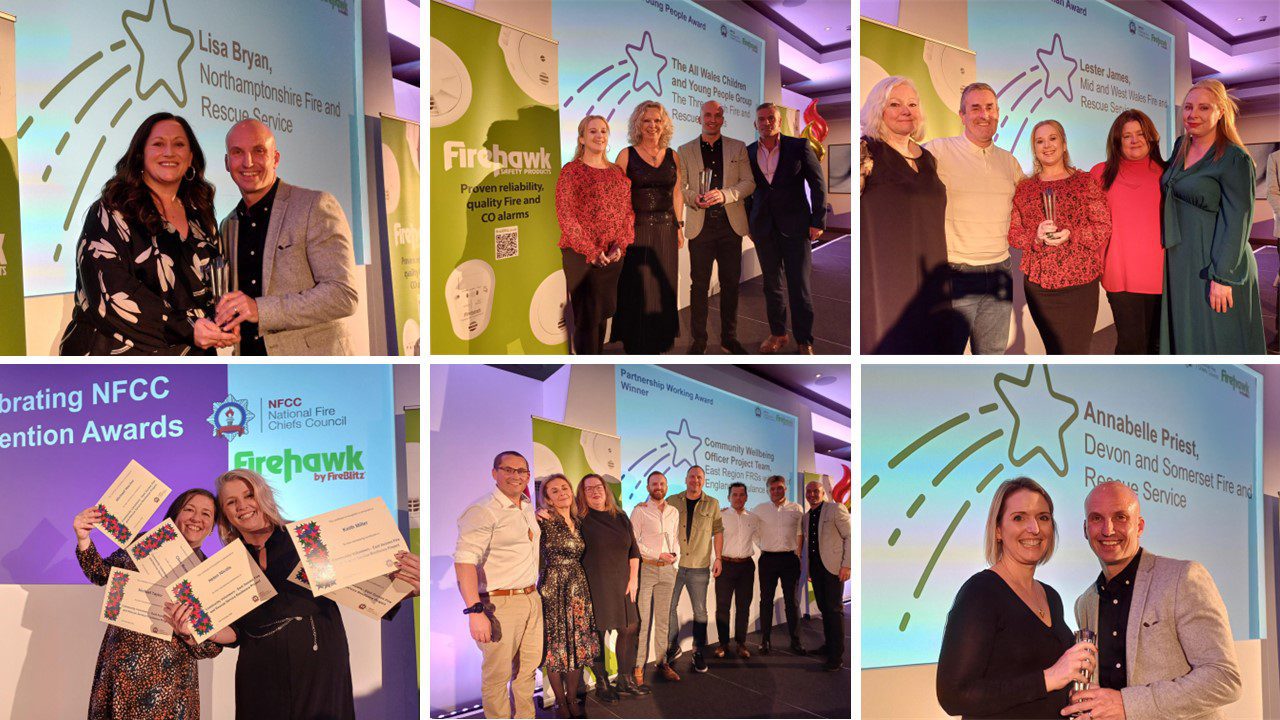
Children and Young People Award – The All-Wales Children and Young People Group, The Three Welsh Fire and Rescue Services.
Home Safety Award – Humberside Prevention Team, Humberside Fire and Rescue Service.
Road Safety Award – Annabelle Priest, Devon and Somerset Fire and Rescue Service.
Safeguarding Award – Lisa Bryan, Northamptonshire Fire and Rescue Service.
Water Safety Award – Prevention Department, East Sussex Fire and Rescue Service
The Donna Crossman, Children and Young People Award – Lester James, Mid and West Wales Fire and Rescue Service.
Partnership Working Award – Community Wellbeing Officer Project Team, East Region FRSs (Bedfordshire FRS, Cambridgeshire FRS and Essex County FRS) with East of England Ambulance Service.
Outstanding Contribution – Dawn Whittaker, CFO East Sussex Fire and Rescue Service and National Water Safety Lead.
2023
Winners 2023
Children & Young People Award – Targeted Education Team, West Sussex Fire and Rescue Service.
Outstanding Contribution Award – Sarah Hardman, Greater Manchester FRS & Thomas ‘throw bag Tommy’ Richardson, Tyne and Wear Fire and Rescue Service.
Partnership Working Award – Staffordshire Falls Response Team, Staffordshire Fire and Rescue Service.
Team Award – Home Safety and Safeguarding Team, Northamptonshire Fire and Rescue Service.
Volunteering – Simon Haycock, South Yorkshire Fire and Rescue Service.
2022
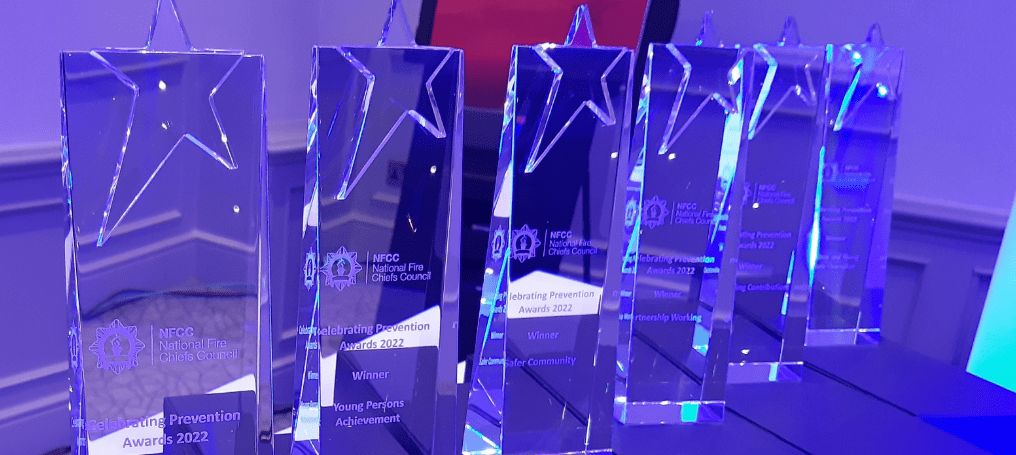
Winners 2022
Big Impact Leadership Award – Dawn Whittaker, East Sussex FRS and NFCC Lead for Water Safety
Children & Young People Champion Award – Coral Jobson, Hertfordshire Fire and Rescue Service.
Outstanding Contribution Award – Tony Firth, West Yorkshire Fire and Rescue Service.
Safeguarding Star Award – Kevin Johnson, Merseyside Fire and Rescue Service.
Safer Community Award – Prevention, Protection, Customer Engagement and Safety – Behaviour Change, Kent Fire and Rescue Service.
Partnership Working Award – Scottish FRS Partnership Approach to Water Safety, Scottish Fire and Rescue Service.
Young Persons Achievement Award – Freddy Hodgson, Northamptonshire Emergency Service Cadets
Volunteering Recognition
To recognise our volunteers that countlessly support fire and rescue services and partnerships across the UK, we will be hosting a certificate of recognition for all volunteers who have been recognised in their service or the Volunteering Network. Nominations are to be submitted for volunteers who are dedicated to developing and delivering our volunteering programs and engagement of volunteers, but most importantly, in recognising their contribution, as members of our communities who generously give up their own free time to support our prevention activities, interventions, youth programs and other initiatives.
- Volunteers must be actively involved in fire prevention or related areas (as identified in the categories above – children and young people, home safety, road safety, safeguarding, water safety, or partnership initiatives).
- Volunteers may be nominated for individual recognition or as part of team recognition (such as those involving Cadets or Safety Centre initiatives)
- Nominations cannot be made for individuals or teams who were nominated the previous year (2024).
2025 - Could it be you?
In the meantime, you can take a look at some of the winners from 2024! All nominations must be made using this form by 12 September 2025.
Nomination Form