
Mobility scooter guidance for residential buildings

Purpose of the guide
This guidance outlines considerations for responsible persons of residential buildings with common areas, such as sheltered housing, blocks of flats, extra care schemes and similar buildings, in establishing the safe use, storage and charging of mobility scooters. However, there may be alternative ways to achieve the necessary protection for users and other residents, outside of those detailed within this guidance. While this guidance focuses on mobility scooters, the same principles could be applied to all assistive technologies that rely on a form of battery power.
It is recognised that the use of mobility scooters enhances the quality of life for many people who may otherwise be limited in their ability to access common facilities within their premises and in the wider community.
The increased use of mobility scooters comes with fire safety risks associated with their storage and charging. The design of many premises, particularly smaller and older premises, does not always easily lend itself to safe storage and charging. The lack of space and the layout of corridors, lifts and stairways in common areas mean that individuals will often leave scooters adjacent to their front entrance doors on protected escape routes or within protected stairways.
When a mobility scooter is involved in fire, the risk of harm is significant. In residential buildings, mobility scooter fires can pose a life safety risk to tenants/residents, employees, firefighters and other relevant persons. Fire tests have demonstrated that a typical Class 2 mobility scooter fire (see section 5) can produce enough toxic smoke to fully compromise a large corridor (floor to ceiling) in less than three minutes. Mobility scooters can also create other health and safety concerns, including potential damage to fire doors and other fixtures and fittings.
This guidance therefore considers a range of relevant factors to enable responsible persons to develop proportionate and risk-based policies around the safe use, storage and charging of mobility scooters. These will act as an enabler to prevent injury and reduce risk to all relevant persons in the event of a fire, promote residents’ independence, and enable responsible persons to comply with all relevant fire safety and health and safety legislation. An application to Building Control may be required when considering undertaking any alterations to existing premises. For new buildings, the provision of suitable spaces for the storage and charging of mobility scooters should be considered at the design stage.
Intended audience
This guide is particularly aimed at those who manage, give advice or enforce standards in residential buildings, examples include, but are not limited to flats, sheltered housing and specialised housing.
Typically, these groups will include:
- The Responsible Person
- Accountable Person
- Principal Accountable Person
- landlords
- local authorities
- managing agents
- facility managers
- health and safety managers
- resident committees
- enforcing authorities
- tenants
- leaseholders
- fire risk assessors
- building safety manager
- developers and architects
Scope of this guidance
This guidance considers a range of possible options and risk reduction measures that those responsible for premises and risk assessors can consider as part of the overall fire risk assessment for individual premises. This guidance should not be considered Article 50 guidance in respect of the Regulatory Reform (Fire Safety) Order 2005.
The use of mobility scooters has become more commonplace as the technology improves, and providers look to meet the needs of the community. For some residents, mobility scooters are their only means of travel beyond the front door of their accommodation. With an ageing population, this trend can be expected to continue.
The number of fires involving mobility scooters in England and Wales remains relatively low, based on the limited statistical information available. The number of fires recorded includes fires in mobility scooters that occur when scooters are stored or charged, both inside and outside the premises. Storing or charging a scooter outside may present less of a risk, although it is recognised that, in such cases, there remains a potential for fire to spread into a building, placing residents at risk. Certainly, the most common causes of fires in mobility scooters are faults with electrical equipment/wiring, charging equipment and arson.
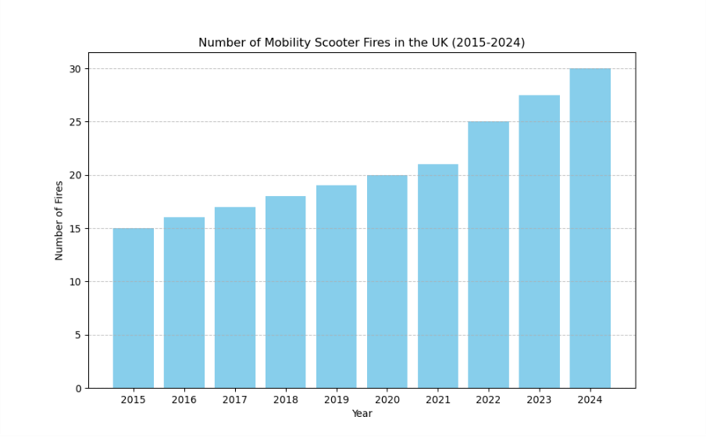
Figure 1: Number of mobility scooter fires in the UK, 2015-2024
From the statistical information available, there have been some fatalities and many others rescued from fires involving mobility scooters (see Appendix 2 for relevant case studies). The root causes of these fires have been both deliberate and accidental, and internal and external to buildings. Many of these incidents have involved fires spreading through doors and windows. These fires have not only caused deaths and injuries, but also disruption to occupants and neighbours through redecoration costs and mobility issues.
Classes of vehicles
Manual and powered wheelchairs and mobility scooters are medical devices for those who cannot walk or who have limited mobility. Legal terminology calls these ‘invalid carriages’. There are three classes of invalid carriage defined in the Use of Invalid Carriages on Highways Regulations 1988:
Class 1
Class 1 are generally considered to be manual wheelchairs, meaning they are self-propelled or attendant-propelled.
Class 2
Class 2 mobility scooters can only be used on footpaths and when crossing roads. They have a maximum speed of 4 mph. This class of mobility scooters does not need to be registered with the Driver and Vehicle Licensing Agency (DVLA).
Key features of Class 2 scooters:
- Small, lightweight, and compact
- Can be used indoors
- Basic driving controls
- Some can be dismantled or folded up to fit into a car boot
- Shorter battery life means they travel shorter distances
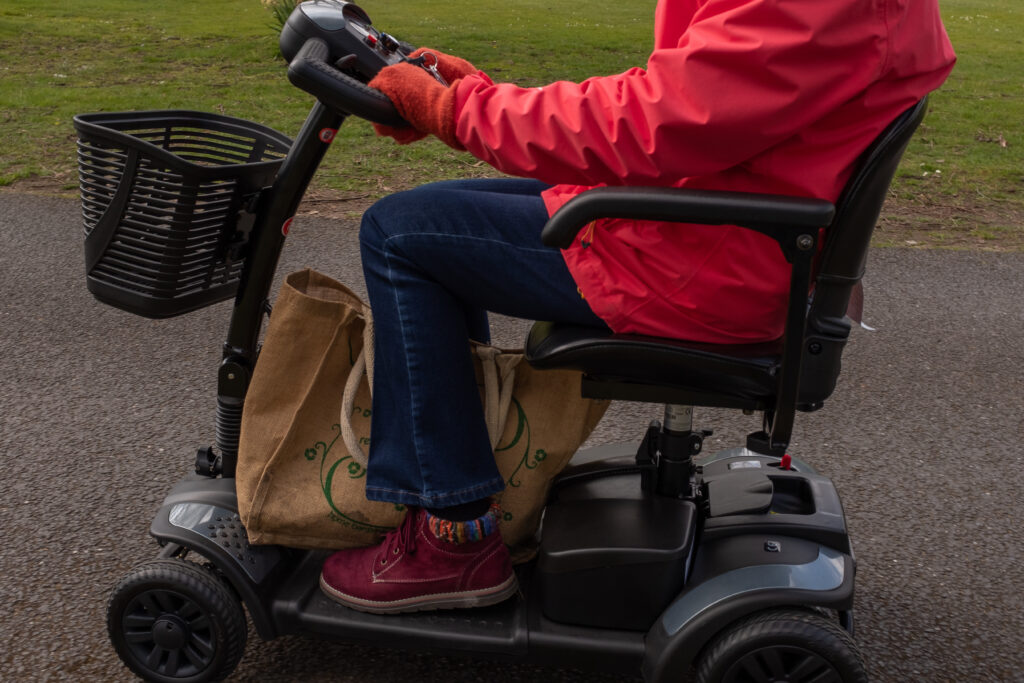
Figure 2: Example of class 2 mobility scooter
Class 3
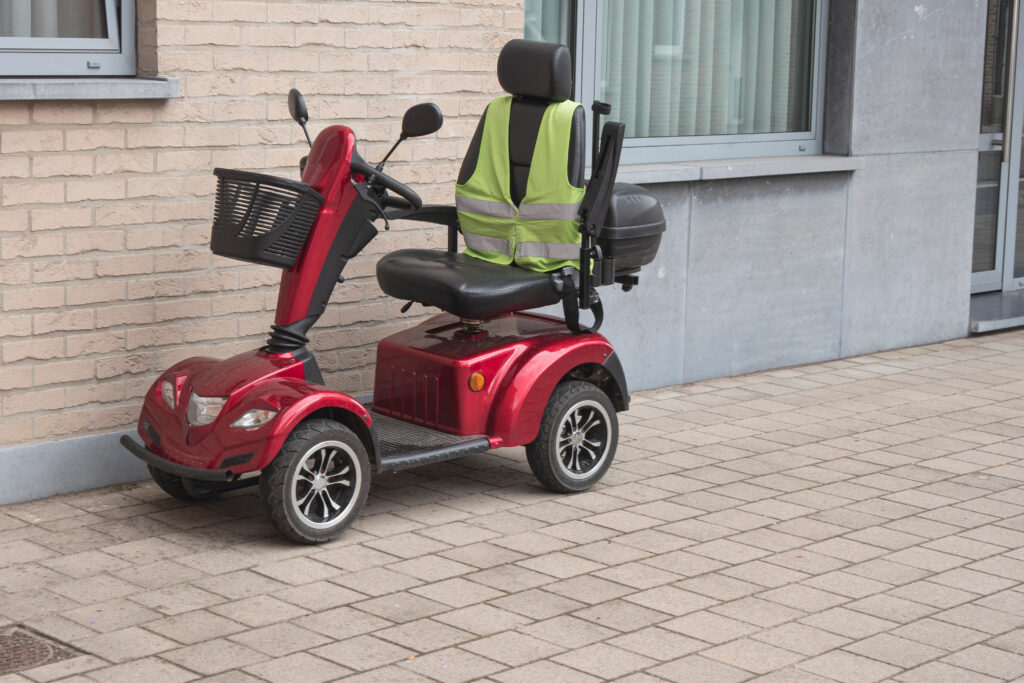
Class 3 mobility scooters are larger vehicles that can be used on the roads and travel up to 8 mph. This class of mobility scooters must be registered with the DVLA.
Key features of class 3 scooters:
- Designed for outdoor use
- Large and robust
- Controls for driving on roads, for example, indicators, lights, and mirrors
- Longer battery life and tougher tyres for longer distances
Powered wheelchairs
Powered wheelchairs differ significantly from mobility scooters, as they are considered to be a medical device for people who require more support . These devices are typically operated by a joystick. They can also be customised to accommodate different forms of disability, such as situations where the user may not be able to hold, talk, or directly control the device. By the nature of their use, powered wheelchairs are likely to be subject to higher standards of manufacture, care and maintenance than mobility scooters. Due to the nature of these devices, they are more likely to be stored and charged within an individual’s private domestic dwellings.

PART A: Fire safety considerations
Understanding the risk
The characteristics of a fire involving a mobility scooter will change depending on its size, materials of construction and power type. Any significant fire involving a mobility scooter will generate significant heat output and large amounts of smoke. Scooters that are powered by lithium-ion batteries have additional significant risks, as these batteries emit significant volumes of toxic gases if involved in a fire. Additionally, they can emit these gases following misuse, fault, damage or overcharging. Battery types are discussed in more detail later in this guidance.
If mobility scooters are stored on common escape routes and are involved in a fire, there is potential that those routes will become impassable and residents will be placed at significant risk. Therefore, appropriate measures must be considered within the building fire risk assessment to address the risks posed by the storage and charging of mobility scooters.
Mobility scooters are often stored outside, giving potential for deliberate ignition. This could allow fire spread on external wall systems, through windows and doors into buildings and internal compartments.
Fire loading
Fire loading refers to the amount of combustible materials present, which can fuel a fire and cause it to spread rapidly. Mobility scooters are generally constructed around a steel frame, with plastic fairings, rubber tyres, foam seats, wiring, and batteries. They are often retrofitted with a vehicle registration number and have waterproof covers and storage bags.
Mobility scooters are powered by batteries, and there are various options to provide this battery power:
- Sealed Lead Acid (SLA) batteries:
These are the most common type of batteries used in mobility scooters. They are reliable and relatively inexpensive. - Lithium-ion batteries:
These batteries are lighter and have a longer lifespan compared to SLA batteries. They are more expensive but offer better performance. - Gel batteries:
These are a type of SLA battery but use a gel instead of liquid acid. They are more durable and can handle deeper discharges.
It is also important to follow proper maintenance and charging practices, ensuring that the correct manufacturer-approved charger is used.
The recent use of lithium-ion batteries to power mobility scooters instead of lead-acid batteries has led to increased fire risks. This is due to the unpredictable and adverse reaction of lithium-ion batteries when subject to damage, misuse and the effects of fire.
Heat release rate
Heat release rates are dependent upon several factors, including the size of the mobility scooter, the materials it is made from, and, importantly, the battery type. Lithium-ion batteries have significantly different characteristics from any form of standard lead battery. They can produce significant toxic vapours prior to any ignition, as well as considerable heat release when ignited.
In 2015, the Building Research Establishment (BRE) published research that demonstrated how mobility scooters react in a fire; these scooters were standardised and had lead-type batteries. Research showed that, within three minutes of ignition, the temperature of the mobility scooter reached 375°C. Between five and eight minutes after ignition, the compartment temperature rose from 54°C to 181°C and continued increasing to 214°C after eight and a half minutes (with the mobility scooter itself reading 556°C).
Toxic smoke
The rate of production and type of toxic products released when a mobility scooter reacts to fire are again dependent upon several factors such as the size of the mobility scooter, the materials it is made from, and – importantly – the battery type. Lithium-ion batteries have significantly different characteristics from any form of standard lead battery.
Lithium-ion batteries pose a significant risk despite being relatively new to the mobility scooter market, as they do not need to be involved in a fire to create a hazardous situation. Mobility scooters and batteries that are purchased second-hand, damaged, misused, tampered with, or incorrectly charged could enter a status known as ‘thermal runaway’. This is a chemical reaction within the battery which can create significant amounts of highly toxic gases in a very short space of time. These gases consist largely of carbon monoxide and hydrogen a pose a serious risk to occupants of a premises.
In tests conducted on standard mobility scooters with lead style batteries, compartment fires involving mobility scooters show that the smoke layer within a 3m high room falls to 2m from the floor after just three minutes, and that thick black smoke extends to just 1m from the floor after eight minutes. The smoke is dense and is given off in large quantities, even at relatively low temperatures. This fills compartments with toxic smoke, possibly before an occupier would notice the fire. The construction materials of some mobility scooters mean that they can quickly produce large volumes of smoke, more so than would normally be expected.
Means of escape
The means of escape is the route that an occupant would take to evacuate the building during an emergency. This route would include corridors, staircases, and doors.
A person’s ability to escape a fire will be affected by smoke and toxic vapours. These not only reduce visibility but can cause incapacitation because of the toxic gases and irritants in the smoke. High temperatures and radiant heat from the flames will also severely affect people’s ability to escape.
Recognising these hazards and providing necessary protections to secure the safe escape of occupants underlies fire safety design in all buildings. It applies equally to residential dwellings as to other buildings.
Given the speed of temperature rise, and rapid smoke and toxic gas production, occupants would need to evacuate very quickly to escape unharmed. A fire in a mobility scooter that is being stored within common exit routes would render conditions untenable in less than three minutes (significantly less if a lithium-ion battery was involved). It is evident that a fire involving mobility scooters within an escape corridor or stairwell will create a substantial risk to occupants, since the smoke and heat will make such routes impassable and put occupants at risk.
In addition, they would introduce obstructions and trip hazards into the means of escape. Such risks should be considered as part of the building fire risk assessment, and steps taken to address such issues as they arise. In some cases, competent advice may be required to ensure that fire safety is not affected.10.6 In the event of a fire, people react differently, and escape routes should always be kept clear to ensure that all persons can reach a point of safety as quickly and as safely as possible.
Mobility scooters place a significant ‘fire loading’ on the escape route(s) and, in the event of a fire, present significant risks to all relevant persons. This means that storage and charging within escape routes should not be acceptable be.
Protected escape routes could become untenable, placing relevant persons (still within their flats) at risk of significant harm.
Storage and charging
In all cases, when determining the storage and charging solutions for mobility scooters in any premises, the following must be considered:
- Has a suitable and sufficient fire risk assessment been undertaken to assess the risks associated with the storage?
- Is there adequate fire detection in place within the proposed storage area to provide early warning to others in the event of a fire?
- Has consideration been given to introducing smoke control systems?
- If the building is not staffed, and fire detection is available for the proposed storage area, is the system externally monitored by an alarm receiving centre?
- Is the level of fire-resistant construction such that it can restrict the fire to the room of origin? The level of fire resistance of rooms storing mobility scooters should be a minimum of 60 minutes. This may be reduced to 30 minutes in a premises with a suppression system.
- If an existing room is to be utilised and repurposed for storage, then consideration must be given to existing ventilation systems that might pass through the room.
- Any additional storage provision must not impact the existing means of escape.
- Are there sufficient electrical sockets available to permit charging where permitted?
- Can charging time be restricted to minimise the risk to those during sleeping hours at night?
- Are there any other combustible materials in the vicinity?
- The storage solution should consider the type and size of mobility scooters likely to use the store
- Does the solution affect other residents?
- Is storage and charging in line with manufacturer recommendations?
- If storage within an individual private dwelling is considered, has an assessment of the suitability been undertaken?
If the mobility scooter is designed so that the end user can safely remove the battery, then this can reduce the risk; however, this should only be done in accordance with the manufacturer’s instructions and never in a situation where it is not designed to be removed. If the battery is removed, then consideration should be given as to where the battery will then be charged and stored.
Should storage within an individual private dwelling be considered as an option, consideration must be given to consent/permissions and insurance outlined below in 13.1. Where this assessment identifies that this dwelling is not suitable, for example, where a resident’s own means of escape from their private dwelling could be affected, then other areas of the building should be considered. This should include assessing existing rooms or areas within the grounds where reasonable adjustments can be made to store scooters. Please refer to ‘Management considerations’ in this guidance for further information
A Person-Centred Fire Risk Assessment (PCFRA) should be undertaken where a mobility scooter is stored within an individual’s private dwelling. Following the completion of the PCFRA, a Residential Personal Emergency Evacuation Plan (RPEEP) may be required. This PCFRA should consider, amongst other things, the implications of using, storing and charging a mobility scooter.
In all residential buildings, the responsible person should have policies in place to ensure that tenants/residents keep all personal belongings within their property; this may include mobility scooters.
Any electrical sockets provided in any designated storage area should be suitable for the charging taking place whilst following the safety instructions of the mobility scooter manufacturer. This should form part of the risk assessment. Consideration should be given to restricting the power supply between the hours of 8pm and 8am, or by using timers that restrict the duration of charging.
Any charging that is undertaken within any designated storage area should be subject to an appropriate portable appliance-testing programme, and subject to risk assessments.
Consideration should be given to removing any unnecessary electrical sockets from common areas. Alternatively, these could be secured so that they can only be used by staff such as cleaners.
Should external storage be considered as an appropriate option, then the following areas should be considered:
- security to prevent arson and theft
- construction and fire spread
- extending any communal fire alarm system
- any impact on external escape routes
- electrical installation
- additional emergency lighting
- location, access and egress
- maintenance
- monitoring
The fire risk assessment should take into account details within this guidance and other relevant factors, to ensure a suitable and sufficient assessment is undertaken.
In all cases, users should ensure that they follow any manufacturer’s guidelines or instructions on the safe use and charging of their equipment.
Storage and charging
In all cases, when determining the storage and charging solutions for mobility scooters in any premises, the following must be considered:
- Has a suitable and sufficient fire risk assessment been undertaken to assess the risks associated with the storage?
- Is there adequate fire detection in place within the proposed storage area to provide early warning to others in the event of a fire?
- Has consideration been given to introducing smoke control systems?
- If the building is not staffed, and fire detection is available for the proposed storage area, is the system externally monitored by an alarm receiving centre?
- Is the level of fire-resistant construction such that it can restrict the fire to the room of origin? The level of fire resistance of rooms storing mobility scooters should be a minimum of 60 minutes. This may be reduced to 30 minutes in a premises with a suppression system.
- If an existing room is to be utilised and repurposed for storage, then consideration must be given to existing ventilation systems that might pass through the room.
- Any additional storage provision must not impact the existing means of escape.
- Are there sufficient electrical sockets available to permit charging where permitted?
- Can charging time be restricted to minimise the risk to those during sleeping hours at night?
- Are there any other combustible materials in the vicinity?
- The storage solution should consider the type and size of mobility scooters likely to use the store
- Does the solution affect other residents?
- Is storage and charging in line with manufacturer recommendations?
- If storage within an individual private dwelling is considered, has an assessment of the suitability been undertaken?
If the mobility scooter is designed so that the end user can safely remove the battery, then this can reduce the risk; however, this should only be done in accordance with the manufacturer’s instructions and never in a situation where it is not designed to be removed. If the battery is removed, then consideration should be given as to where the battery will then be charged and stored.
Should storage within an individual private dwelling be considered as an option, consideration must be given to consent/permissions and insurance outlined below in 13.1. Where this assessment identifies that this dwelling is not suitable, for example, where a resident’s own means of escape from their private dwelling could be affected, then other areas of the building should be considered. This should include assessing existing rooms or areas within the grounds where reasonable adjustments can be made to store scooters. Please refer to ‘Management considerations’ in this guidance for further information
A Person-Centred Fire Risk Assessment (PCFRA) should be undertaken where a mobility scooter is stored within an individual’s private dwelling. Following the completion of the PCFRA, a Residential Personal Emergency Evacuation Plan (RPEEP) may be required. This PCFRA should consider, amongst other things, the implications of using, storing and charging a mobility scooter.
In all residential buildings, the responsible person should have policies in place to ensure that tenants/residents keep all personal belongings within their property; this may include mobility scooters.
Any electrical sockets provided in any designated storage area should be suitable for the charging taking place whilst following the safety instructions of the mobility scooter manufacturer. This should form part of the risk assessment. Consideration should be given to restricting the power supply between the hours of 8pm and 8am, or by using timers that restrict the duration of charging.
Any charging that is undertaken within any designated storage area should be subject to an appropriate portable appliance-testing programme, and subject to risk assessments.
Consideration should be given to removing any unnecessary electrical sockets from common areas. Alternatively, these could be secured so that they can only be used by staff such as cleaners.
Should external storage be considered as an appropriate option, then the following areas should be considered:
- security to prevent arson and theft
- construction and fire spread
- extending any communal fire alarm system
- any impact on external escape routes
- electrical installation
- additional emergency lighting
- location, access and egress
- maintenance
- monitoring
The fire risk assessment should take into account details within this guidance and other relevant factors, to ensure a suitable and sufficient assessment is undertaken.
In all cases, users should ensure that they follow any manufacturer’s guidelines or instructions on the safe use and charging of their equipment.
PART B: Will my building support a managed approach?
The provision of safe storage and charging facilities in some premises will prove difficult. In certain locations, it may not be physically possible to provide suitable storage or charging facilities, either internally or externally. In these situations, it is recognised that it may not be possible to allow residents to store or charge mobility scooters in these locations owing to the size, design, layout and access to the building.
The layout and design of each building will be different. The type, number and location of mobility scooters will also differ, and the needs of individual residents should be considered as part of the overall assessment of risk. A solution that might be appropriate in one building may not be acceptable in another. Likewise, a solution that might be appropriate for one resident may not be appropriate for other residents. Although external storage could be considered as an option, the vulnerability and mobility of residents may make it impracticable for them to utilise external facilities.
Many landlords and housing providers apply policies that prevent mobility scooter storage in unstaffed residential buildings. This is because these buildings have been identified as not being designed in a way that supports safe storage or charging; or if storage solutions have been identified, they may meet any maximum capacity set for the building. In all cases where such policies exist, this should be identified as part of the premises fire risk assessment for the building and recorded.
In specialised housing, especially where schemes are staffed, a managed approach could be more effective at meeting residents’ needs; however, the fire risk assessment should determine this.
The options detailed below present a solutions-based approach that could be applied to any mobility scooter situation identified, depending on the circumstances.
Storage options for mobility scooters – key considerations
Before selecting any storage solution for mobility scooters, a comprehensive fire risk assessment must be carried out. This assessment should identify potential hazards and determine the most appropriate option for the specific premises. The Responsible Person may also need to consult with other specialists as part of this assessment, for example fire engineers, care providers and end users.
Where the following options refer to fire-resisting construction or fire-resisting doors, a fire resistance rating of 60 minutes should generally be applied. However, if the storage area is equipped with automatic fire suppression and early warning, a reduced fire resistance rating of 30 minutes may be deemed sufficient.
Option 1: External parking with charging facilities
The parking of mobility scooters outside premises is potentially an option. In most instances, it would be expected that a charging facility would be provided adjacent to the parking area. Security and the risk of arson would need to be considered, along with the location. The location should be subject to a suitable premises fire risk assessment, which should assess the risk of fire spread into the building in the event of a fire.
Option 2: External storage with charging facilities
The provision of purpose-built secure storage and charging facilities (including individual storage units), or the conversion of existing external facilities such as garages or storerooms to provide storage and charging facilities, might be considered. Dependent on their location and proximity to the building, such facilities may need to be fire-resistant enclosures and may also be fitted with automatic fire detection if they can be monitored. The location should be subject to a suitable premises fire risk assessment, which should assess the risk of fire spread into the residential building in the event of a fire.
Option 3: Purpose-built internal storage rooms
The provision of purpose-built rooms inside premises for the storage and charging of one or more mobility scooters should be enclosed in fire-resisting construction, and be fitted with fire-resisting, self-closing doors and automatic fire detection. These rooms should be at ground floor level and accessed directly from the outside of the building, for both mobility scooter users and firefighters. This avoids a number of risks associated with mobility scooters accessing the storage room via internal corridors, and severe smoke/fire affecting internal corridors during firefighting. An automatic smoke extract system venting directly to the outside should be provided for the same reason.
The room should also have a comprehensive fire detection and alarm system automatically linked to an alarm receiving centre. The provision of an automatic water suppression system is also strongly recommended. Suitable charging facilities should be provided. Consideration should be given to restricting the power supply between the hours of 8pm and 8am.
Option 4: Adapted internal rooms
The provision of specifically adapted rooms inside premises for the storage and charging of one or more mobility scooters may be an option. Rooms would, as a minimum, need to be enclosed in fire-resisting construction and be fitted with fire-resisting, self-closing doors and automatic fire detection. These rooms should be at ground floor level and accessed directly from the outside of the building for both mobility scooter users and firefighting. This avoids several risks associated with mobility scooters accessing the storage room via internal corridors, and severe smoke/fire affecting internal corridors during firefighting. An automatic smoke extract system venting directly to the outside should also be considered.
The room should also have a comprehensive fire detection and alarm system that is automatically linked to an alarm receiving centre. The provision of an automatic water suppression system is also strongly recommended. Suitable charging facilities should be provided. Consideration should be given to restricting the power supply between the hours of 8pm and 8am.
Option 5: Storage and charging within individual domestic dwelling
Suitable storage and charging arrangements might be possible inside the accommodation of individual residents. This option removes the risk from the common areas, and it places the storage and charging of scooters within a fire-resisting enclosure beyond a fire-resisting, self-closing door. However, this potentially places individual residents at risk from a fire involving a mobility scooter in their own home. Residents should be provided with advice on the safe use and charging of scooters as part of a person-centred approach.
Option 6: Internal storage in other areas
If mobility scooters are stored in any other areas not mentioned in the above options, this must be thoroughly fire risk assessed.
The Responsible Person should ensure the maximum number of mobility scooters identified for the premises is recorded in the fire risk assessment. Residents should be aware of local arrangements which will help to future-proof mobility scooter storage issues in buildings.
PART C: Management considerations
Consent, permissions and insurance
Responsible persons should ensure that procedures are in place to highlight any organisational mobility scooter policies and conditions of permission to new and existing residents.
In all cases, responsible persons should ensure they give permission and consent for a resident to store a mobility scooter within a building. Responsible persons reserve the right to refuse storage where none of the options in this guidance are suitable, and/or this would breach legislation/policy, or impact on the health, safety or welfare of other occupants within the premises.
Expectations should also be appropriately identified and supported within tenancy agreements and communicated to residents.
Maintenance and testing
Residents should ensure that mobility scooters are maintained in line with manufacturer recommendations. This should include mobility scooter usage and charging.
Responsible persons should ensure that appropriate maintenance and testing regimes are in place to ensure any designated storage areas are fit for purpose and offer effective fire protection, including:
- fixed wiring installation testing
- portable appliance testing of equipment
- fire detection maintenance and testing
- fire doors and fire door furniture
- emergency lighting
- fire suppression systems
- ventilation
- inspection of floors, walls or ceilings
Alterations
Any alterations made to existing premises should be reasonable and proportionate. It is possible that not all requests now or in the future can be catered for in buildings. Therefore, responsible persons should identify the capacity of their buildings to cater for mobility scooters and communicate this with tenants/residents where appropriate.
Any alterations made should be risk assessed, and all fire safety considerations considered prior to any alterations being made.
Any material alterations considered may also require Building Control approval. Additionally, for buildings within scope, an application to the Building Safety Regulator may also be needed.
Local considerations
The demands and uses placed on buildings can vary significantly, based on building design, fire strategy, occupancy and behaviours. Therefore, a one-size-fits-all (or prescriptive approach) will provide neither a reasonable nor proportionate approach in managing risk.
Responsible persons should set expectations with residents on any local rules for the premises. Any local rules implemented should be clearly communicated to residents and monitored.
While the Fire and Rescue Authority regulates the Regulatory Reform (Fire Safety) Order 2005, the Regulators’ Code places an expectation on the Authority to work with local businesses and provide support.
Appeals
As noted in Part A and B of this guidance, it is important that responsible persons identify a building’s suitability and the maximum capacity of mobility scooters it can accommodate, taking into account any fire safety/local considerations.
Responsible persons should have procedures in place for when permission or consent is refused. In such cases, there should be an appeals process that residents can follow.
Incident reporting
Responsible persons should ensure that appropriate reporting procedures exist. This will ensure that relevant persons are able to report any incidents that could have an impact on the health, safety or welfare of other persons.
In the event of any fire incident involving a mobility scooter, however small, responsible persons should inform their local fire and rescue service. In addition, a report should be made to the Medicines and Healthcare Products Regulatory Agency (MHRA), which is responsible for regulating medical devices including mobility scooters. The make and model of the scooter involved will be required as well as the details of the incident. To report a fire incident involving a mobility scooter, please visit the Yellow Card Reporting Site.
In addition to the above reporting, the Building Safety Act 2022 has made it a statutory requirement for those responsible for high-risk buildings (typically 18m or 7-storey residential premises) to report significant events, which would include fire safety events. These events should be reported to the Building Safety Regulator by means of Mandatory Occurrence Reporting. The accountable person or principal accountable person must submit a report following each reportable event.
In addition, Responsible Persons should ensure a review of the building’s fire risk assessment is made following any fire incident.
Appendix 1: Case studies
Case study 1
Date: 2008
Details:
A fire at a care home was traced to a power surge affecting a mobility scooter stored indoors. The scooter’s fibreglass casing ignited, producing a blowtorch-like effect from its overheated battery, breaching a ceiling rated for 60 minutes of fire resistance.
A subsequent, similar fire in the area led the fire and rescue service to implement a new policy requiring all mobility scooters and their charging units to undergo regular servicing.
Outcome:
Following the fire, the care home has now been fitted with a circuit specifically dedicated for the use of mobility scooters, which only operates between 09:00 and 19:00.
Case study 2
Date: 2025
Details:
A fatal fire within a residential dwelling. The subsequent fire investigation determined that the lithium-ion batteries within a mobility scooter that was on charge had gone into ‘thermal runaway’ and started the fire. The fire caused significant damage to the property (Figure1), and conditions became so overwhelming that the occupant was unable to evacuate.
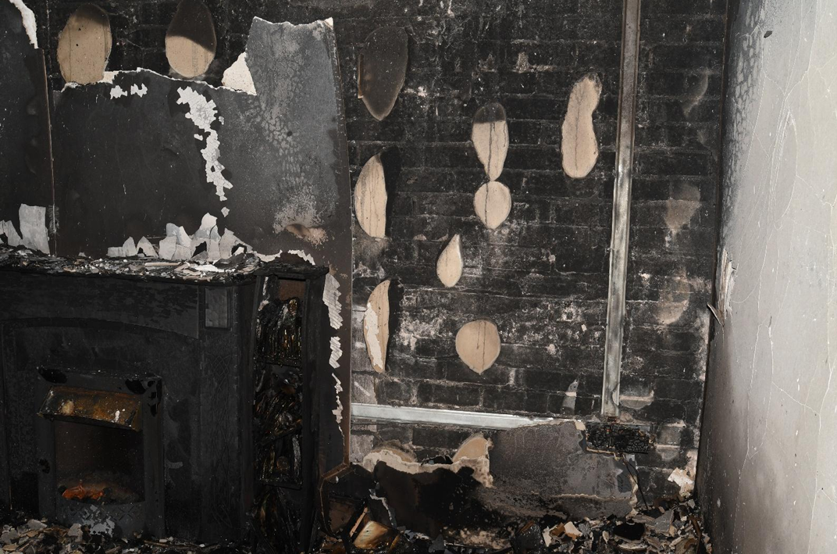
Figure 1: Significant fire damage within the property close to where the mobility scooter ignited
The location of the mobility scooter within the property exhibited the most severe fire damage, with the remains of the scooter barely recognisable:
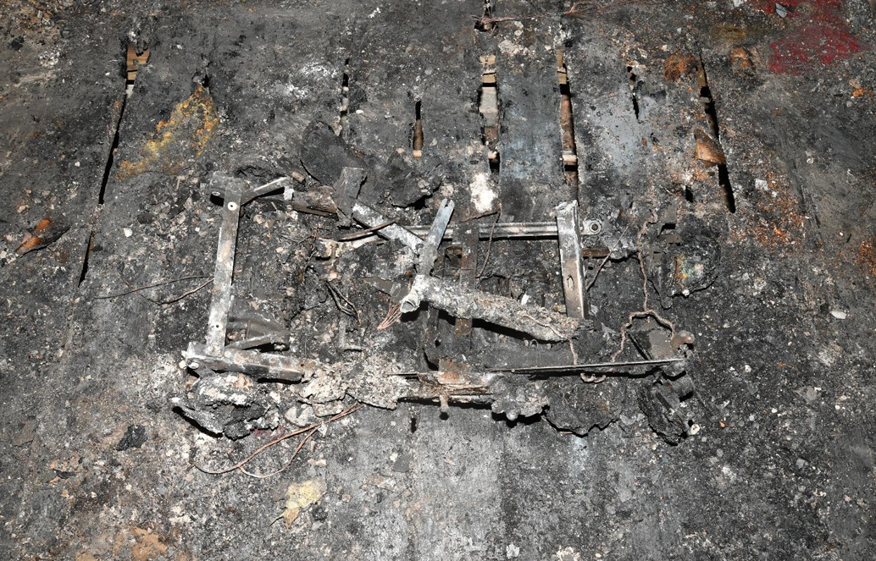
Figure 2: Remains of the mobility scooter following the fire
Outcome:
An electrical fault occurred in the lithium-ion batteries within the scooter while it was charging.
Case study 3
Date: 2010
Details:
The double fatal fire occurred at 02:58 while the occupants were sleeping. The mobility scooter was being stored directly outside the property, and the occupants were awoken by a noise outside. An orange glow could be seen through the front door. On arrival, the fire and rescue service the fire was well developed and so intense that fire had spread to the canopy area above the scooter.
Outcome:
The cause of the fire was considered to be deliberate, with the location of the mobility scooter next to the property being a contributory factor. This guidance suggests that external storage of mobility scooters should be subject to a suitable and sufficient fire risk assessment.
Case study 4
Date: 2016
Details:
Five appliances attended a fire in a four-storey sheltered accommodation block. Three people were unable to evacuate from the building and had to be led to safety by fire crews wearing breathing apparatus. The incident led to eight people being treated for smoke inhalation.
Following the fire, an investigation was carried out, and the cause of the fire was determined to be a mobility scooter which was charging within the common area. Findings indicate a fault within the charging point of the scooter.
Appendix 2: Legislation, Technical standards and other publications
There are several pieces of legislation and guidance relevant to mobility scooters. These include, but are not limited to:
Legislation
- Regulatory Reform (Fire Safety) Order 2005
- The Fire Safety (Scotland) Regulations 2006
- The Fire Safety Regulations (Northern Ireland) 2010
- Fire Safety (Residential Evacuation Plans) (England) Regulations 2025
- Equality Act 2010
- Building Safety Act 2022
- Management of Health and Safety at Work Regulations 1999
- Use of Invalid Carriages on Highways Regulations 1988
- The General Product Safety Regulations 2005
British Standards
- BS 9991:2024 Fire safety in the design, management and use of residential buildings
- BS EN 12184:2022 Electrically powered wheelchairs, scooters and their chargers. Requirements and test methods.
- BS 8674:2025 Built environment. Framework for competence of individual fire risk assessors
- BS ISO 16840-10 :2021+A1:2024 Wheelchair seating – Resistance to ignition of postural support devices. Requirements and test method
- BS EN 12184:2022 (all parts) Electrically powered wheelchairs, scooters and their chargers
- BS EN 60601-1:2006+A13:2024 Medical electrical equipment – General requirements for safety
- BS EN ISO 14971:2019+A11:2021 Medical devices. Application of risk management to medical devices
- BS EN ISO 21856:2022 Assistive products. General requirements and test method
- BS 9792:2025 Fire Risk Assessment – Housing – Code of Practice
- BS 9792:2025 – TC | 1 Aug 2025 | BSI Knowledge
- BS 9991: 2024 Fire safety in the design, management and use of residential buildings. Code of practice
- BS 9991:2024 | 26 Jun 2025 | BSI Knowledge
Other guidance
- Fire safety in purpose-built block of flats (government guidance)
- Practical fire safety for existing specialised housing and similar premises
- RC59 “Risk Control: Fire safety when charging electric vehicles” 2023 published by the Fire Protection Association on behalf of RISC Authority
- NFCC Specialised Housing Guidance
- Office of National Statistics: Population estimates for the UK, England, Wales, Scotland and Northern Ireland – Office for National Statistics
- Using mobility scooters and powered wheelchairs: Overview – GOV.UK
- Fire experiments on mobility scooters protected by sprinklers, BRE May 2015
- Heat release and smoke production from burning mobility scooters, BRE May 2015
- The Low Voltage Directive 2014/35/EU
- Medical Devices Directive 93/42/EEC – The Medicines and Healthcare Products Regulatory Authority (MHRA)
- Council Directive 97/28/EC, adapting to technical progress
Acknowledgements
When reviewing this guidance, the National Fire Chiefs Council (NFCC) acknowledge previous contributions to the original guidance from:
National Social Housing Fire Strategy Group
NFCC Fire Engineering and Technical Standards Committee
Midlands Social Housing Fire Strategy Group
Wales Social Housing Fire Strategy Group
Midland Heart
Staffordshire Fire and Rescue Service
Greater Manchester Fire and Rescue Service
London Fire Brigade
Sanctuary Housing
Orbit Group
Hanover Housing
Bromford Group
The Community Housing Group
Horizon Medical
Building Research Establishment
Lewisham Homes
Mid and West Wales Fire Service